Austin, Minnesota, is Spamtown. Hormel has been there for more than a century, and for much of the twentieth it was hard to separate the history of the company from the history of the place. In August 1985 a strike began that split the town in two. Five months later, the National Guard was protecting the plant’s replacement workers. John Maus was five years old. He may not remember any of it.
Still, it’s hard not to think of that town when a musician born there has spent twenty years coming back to a similar idea: people who turn up in a street and declare that it belongs to them too. He has arrived at it by way of synthesizers that nearly everyone heard as the eighties, the philosophy of Alain Badiou and a doctoral dissertation on societies of control. Today he also arrives at it by way of liturgy and medieval metaphysics. In between, there was January 6 in Washington.
His music sounds like a 1987 television set that has accidentally tuned in to a monastery.
I ask him what he’s trying to pick up.
Spamtown
Maus remembers Austin through a film. American Dream, Barbara Kopple’s documentary about the Hormel strike, has a mise-en-scène that is, for him, “almost exactly my childhood, down to the film grain.” In 1985, while the plant’s workers were fighting wage cuts and the town was beginning to divide around the dispute, Maus was a five-year-old boy.
“It’s a fair picture of my generation,” he says. A generation that grew up as the New Deal order came apart and a large part of American manufacturing disappeared. From there, Maus says, we have arrived at something perhaps stranger still: “permanently managed disintegration, the constant modulation and control of everything.”
He draws a line from Richard Knowlton, then the head of Hormel, to Elon Musk and Jeff Bezos. “Which is somehow much worse.”
It isn’t hard to see here the future doctoral student who would spend years studying societies of control. But it would be too convenient to turn a strike that happened when he was five into the explanation for everything that came after. Maus doesn’t do that. Nor should I. What does appear again and again in his work is a suspicion of closed systems: institutions, the market, networks, ways of listening, even the categories critics use to put music in order.
In 2011 he released We Must Become the Pitiless Censors of Ourselves. The title came from Alain Badiou. He still stands by the phrase today. “Absolutely. The idea is even more apropos now than it was fifteen years ago.”
Then Maus returns to a formulation that has stayed with him for a long time: “all art, and all thought, is ruined when we accept this permission to consume, to communicate and to enjoy.”
It would be easy to read those words as one more lament about the internet. He goes a little further. Influencers, box openers, content creators: the utter banality of that culture might, paradoxically, contain a possibility. The spectacle would have expropriated the common so completely that it finally left it exposed. Every content and every identity ends up emptied out, leaving pure communicability with nothing to communicate.
He wonders what that might mean for music. Maybe restriction. Negation. Deliberateness. Recta ratio. But Maus immediately brings in the contradiction: some of the best music comes out of exactly the opposite impulses. “So I really don’t know, even if I remain certain that it must finally come down to something other than the imperative to consume, communicate, and enjoy.” Maybe what matters is that “I don’t know.” For years people have written about Maus as if every statement he made hid a complete system behind it. In conversation he is more interesting when the system hits a limit.

Inside the Box
For a long time it was almost impossible to write about John Maus without mentioning the eighties.
Analog synthesizers, cavernous reverb, synth bass, deep voices that seemed to be coming from an abandoned discotheque. His music was placed alongside Ariel Pink’s and, later, inside the haze critics called hypnagogic pop: songs recorded at home that seemed to remember the pop culture of earlier decades imperfectly, like a tape found after too long in the sun.
The trouble is that a synthesizer doesn’t remember 1983. We do.
I put it to him that way, and Maus says he isn’t sure how much that’s “still the case.” “It definitely was when I started putting out music in the 00s, but young people have had Stranger Things and vaporwave and the rest of it for a long while now.”
When he started releasing music, that sound pointed almost automatically to a decade. Then came several generations recycling the same codes. Maybe they no longer mean the same thing. What Maus does point to is another genealogy. “None of that equipment was built for music anyway.”
He talks about the German Magnetophon, about hi-fi and military listening, about stereo, about U-boats, about the vocoder built to secure communications. He cites the German theorist Friedrich Kittler, for whom much of the modern history of media couldn’t be separated from the military history that produced its machines. “Kittler calls rock music a misuse of military equipment, and he means it literally.”
Seen that way, reaching for magnetic tape or an old synthesizer doesn’t necessarily mean going back to a lost decade. It means taking the leftovers of an apparatus built for something else and making it do something its builders never imagined.
“Somebody who hears a decade in it isn’t wrong, but what’s in the box is the war, the entire post-war order.” The line changes the picture considerably. Suddenly what looked like nostalgia also becomes technological archaeology. Machines don’t contain memories: they contain earlier uses. What we call a vintage sound can also be the domesticated ghost of a device built to locate submarines, scramble a conversation or tell enemy engines apart.
Here is one of the most interesting paradoxes about Maus. His music has been accused for years of looking backward, but he seems to hear in old technologies something that hasn’t finished happening yet.
He isn’t necessarily looking for the past. He’s looking for what the past left unused.
“Somebody who hears a decade in it isn’t wrong, but what’s in the box is the war.”
The Machine That Was Supposed to Learn to Write
In 2014, at the University of Hawaiʻi, Maus completed Communication and Control, a doctoral dissertation on contemporary forms of power. His concern was less what a person thinks than how networks can anticipate, modulate and correct their behavior.
When I ask him what the dissertation got wrong, he starts with what it got right. “The diagnosis holds up better than I’d like.” Control through external relations. Behavior over interiority. Negative feedback. Preemption acting on a future before it arrives. All of that, he thinks, has intensified. What he didn’t see coming was something else: the collapse of institutions, the return of nationalism, the rise of reaction. But his fundamental mistake wasn’t in the diagnosis. It was in the exit.
Maus had bet on positive feedback: “playing the powers that be their own melody.” And at the same time he had taken his critique of identity so far that he “argued the person out as well.”
“An act with nobody in it can’t be imputed to anyone, so I had no way to say why a rising was better than a ruin, or who it was for.”
That line will come back several times in the conversation.
Before it does, an unexpected story. While he was writing the dissertation, Maus decided that a machine ought to be able to write. He had no computer science background. He taught himself Java. He scanned and hand-tagged seventy-six books of continental philosophy, plus a couple of thousand more texts. He turned them into vectors, built rudimentary language models and waited for something resembling a sentence to come out of it all. “It mostly produced gibberish.”
GANs appeared in 2014, and Deep Dream arrived in 2015. Maus dates the GAN breakthrough to 2018. Then came DALL-E and, finally, the generative-AI explosion that turned a fairly eccentric obsession into an industry. Maus doesn’t seem surprised. The surprise, he says, was how long he had to wait.
He remembers those years shut away in “a shitty tiny hot room in Austin,” right after Pitiless, when he could have moved to Brooklyn to work on his “mUsIc cArEeR.” Instead he built a GPU machine and fed models spectrograms, Gregorian chant and old demos. But here, too, there is an important difference between what he was after and what the technology finally became. He didn’t want to type in lyrics and get a finished song back.
“The least interesting possible use of the technology.” What he wanted was something else. “A synthesis engine for sounds that don’t exist, a machine that absorbs a world of music and hallucinates from the inside.”
The failures were precisely what was interesting: sixteen-second clips, impossible choirs, everything slightly underwater, artifacts, time falling apart in the middle of a phrase.
An artificial intelligence not as a substitute for the musician, but as an accident. A machine capable of going wrong in a way we don’t yet have memories for.
“I wanted a synthesis engine for sounds that don’t exist, a machine that absorbs a world of music and hallucinates from the inside.”
A Politics with Nobody in It
On January 6, 2021, John Maus was in Washington with Ariel Pink and the filmmaker Alex Lee Moyer during the demonstrations that ended in the storming of the Capitol. Pink said publicly that he had gone to show his support for then-President Trump. Maus says he left before the trouble began. He had donated to Bernie Sanders, by his own account, and it later emerged that he had also donated to the Trump campaign. His public response that afternoon was to post Mit brennender Sorge on Twitter: Pius XI’s 1937 encyclical, which condemned, among other things, the deification of race, people and state. Ambiguity did the rest.
For years Maus had described politics as those moments when a crowd physically appears and breaks the existing distribution of places, bodies and voices. January 6 confronted that theory with an uncomfortable question: what happens when a crowd you reject also meets the formal conditions you had used to define a political event?
“It’s all on me, I don’t know. The internet is pretty fuckin’ stupid too, though, that’s for sure. It makes me sick.”
He had thought of politics as the eruption of unqualified existence against whatever decides who counts and who doesn’t. No program. No demands. Nobody in particular in it. A rising that is for itself.
But take the person out, he explains now, and there’s nobody left for a rising to be for, and nobody to whom a wrong can be done. Take out the common good, and no order can be judged worse than another. Take out reason, and you can’t explain anything to someone who doesn’t already share your premises.
A rising that is for itself needs none of those three things. That was precisely its appeal. “And it’s also why I had no sentence available that day.”
And here comes one of the hardest lines of the whole conversation. “So when people started calling me a Nazi, they had the wrong name and the right shape.” Nothing he believes, he says, is in that word. But he admits that the people judging him were tracking something real: “a man carrying a politics with nobody in it.”
He mentions Tiqqun and the Invisible Committee, two names that emerged from the French post-Situationist and insurrectionary milieu of the late nineties and the 2000s, where the absence of a program and the interruption of order took on a political value of their own.
A politics with nobody in it has no way to refuse anything, either.
“I’d rather concede that than keep a doctrine that left me with nothing to say.” I ask him directly whether January 6 changed what a crowd means to him. He says no.
“It showed me that my political theory had no way to tell one crowd from another.”
“Everything I’d said politics was, no program, no demands, unqualified existence asserting itself against the count, was on the screen that day. By my own criteria it qualified.”
He recalls a line from the Invisible Committee: “we can’t help but delight in the fits of anger and disorder wherever they erupt.” The problem, Maus says, is wherever. Because telling one thing from another takes a criterion. And he had none. That afternoon he posted Mit brennender Sorge. An encyclical. A document that could return a verdict where his own theory couldn’t. “A crowd isn’t self-justifying.”
“Whether an assembly is political in any sense worth the name depends on what it’s for and who it’s for, and the gathering by itself can’t tell you either.” There’s no need to build a conversion around that gesture. It’s enough to notice that, at the moment his own system couldn’t give him a criterion, Maus reached for one that could.
“My political theory had no way to tell one crowd from another.”
Ariel Pink and the Tapes
Ariel Pink turns up again and again in this story. They met at CalArts in the late nineties. They played together. They traded recordings. Maus still considers Pink’s early records essential to understanding his own relationship with music.
When I was preparing these questions, I was interested in one particular image. Maus had once described trading tapes with Pink as a small picture of a better world. Years later he talked about spending hours in front of a screen. It seemed too perfect: the tape replaced by the interface, a small analog utopia swallowed by the network.
I asked him. Maus took the metaphor apart in two sentences. “The technology changed, i.e., from tape decks to computers. I still use tape, though, for what it does to the sound.” It may be one of my favorite answers in the whole interview. Because I had built a story about loss, and he simply saw a change of equipment.
It’s worth remembering when writing about musicians especially liable to become symbols. Sometimes a tape deck is just a tape deck. His friendship with Pink hasn’t broken. “He’s honestly one of the few, and oldest, friends I have.” Maus regrets that being implicated in all of it himself kept him from going to bat for Pink harder in public. And the conversation quickly turns back to music. “My whole understanding of this music stands or falls on those records, especially the first nine or whatever. If they’re not important anymore, then nothing I’m doing, downstream of them, is important either.” It doesn’t sound like a statement about reputations.
It sounds like a debt.

Asking for the Kingdom, Getting a Bank Commercial
There’s another recent idea of Maus’s that’s hard to ignore: perhaps post-war popular music is a single historical event that is starting to run out. I ask him what the last record of that event would sound like. He says he doesn’t know.
Part of what characterizes this music, he explains, is precisely the absence of any telos, any narrative of development. What there has been instead is constant repackaging of the same thing, with more and more packages and more and more “scenes.”
He has a clearer idea of what the next music might be: generated by nets for each individual person, off their biofeedback.
“That’s what we’re asking when we write, I guess. Hopefully, I’ll make that record!”
Fifteen years ago, Maus turned to Jacques Rancière to explain that a song could show that things might be organized differently. Not because it carried a political message, but because it could shift the line between what an order recognizes as speech and what it files away as noise.
Maus says that idea hasn’t changed. What has changed is his mood. He’s more “blackpilled,” as the kids say, than he was at twenty-six.
After “twenty long years of Max Martin and poptimism, of cyborgs telling us everything we see is good,” he’s “pretty tired.”
“Things did not go down the way my dumb ass thought they were gonna go down.”
When Maus says he’s more blackpilled, he’s using internet slang for a much deeper pessimism about the possibility of changing things. Max Martin is the Swedish producer behind a large share of mass-market pop over the last few decades; poptimism, the critical current that challenged the old hierarchy granting “serious” rock more legitimacy than commercial pop.
Everyone is audible now. And what that bought, Maus says, is “a machine that will play you something nobody has ever heard, for you personally, forever.”
Maus has never tried to refute the old critique of Theodor W. Adorno, the German philosopher who saw in industrialized popular music a reflection of the economic structures that produced it:
“Every count against this music is true. It mirrors the power that made it in all the ways Adorno said.”
And then he says something far crueler:
“The negation, where there was one, asked for the Kingdom and got another bank commercial.”
Today he would put what a song can still do differently. “The truth of this music was never sociological, and the question is technical and always was.” It is, he says, the first music in centuries to abandon thematic development and to sit neither inside nor against the narrative of harmonic-tonal relationships, but simply outside.
“The fragment got loose from the whole and the loss never arrived.”
What Badiou Couldn’t Say
When I was preparing the interview, one of the questions seemed especially clear. Badiou had been a central reference for Maus for years. Now liturgy, scholasticism and classical metaphysics were turning up. I asked him what Aquinas had given him that Badiou couldn’t.
It was the wrong question.
“I actually haven’t spent much time with St. Thomas.” What he has read are the so-called transcendental Thomists — Joseph Maréchal, Pierre Rousselot, Karl Rahner — and some old scholastic manuals.
Maus says he is more and more convinced that the classical tradition, from Parmenides through the schoolmen, has “a better and more workable metaphysics” than the moderns, and above all than the French philosophers of the sixties who shaped his education.
Badiou can tell him what being is: “inconsistent multiplicity written in set theory.” But never “that anything is at all.”
That is where he now finds the classical tradition’s interest: in the difference between what a thing is and the fact that it is. “The finite ‘is’ is had, not owned,” and “the new isn’t a rupture from outside the count but the structure of every finite thing.”
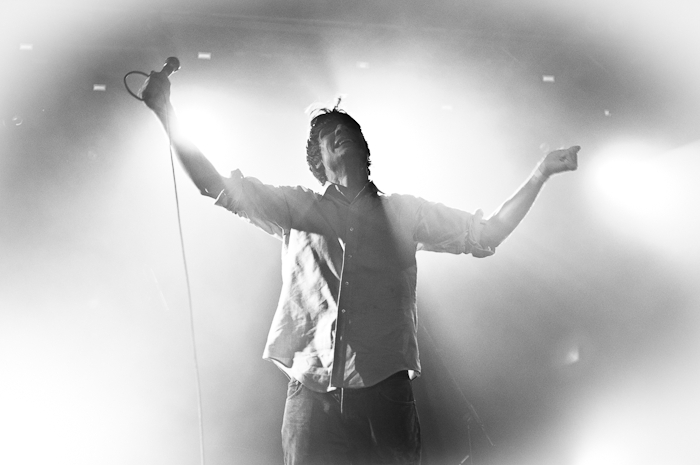
The line seems a long way from the musician drenched in sweat, shouting over a synthesizer track in front of a packed room. It’s the same man.
When I ask him about faith, Maus first pins down the term. For him it has a technical meaning. If we accept the scriptural definition, “substance of things hoped for,” any radical politics also involves some form of fidelity. Badiou used exactly that word.
The difference comes when he distinguishes that fidelity to a reconciled world from faith as a supernatural virtue, directed toward revealed truth. The Christian tradition would hold that the second “perfects” the natural.
And that doesn’t make the demands any lighter. “In practice that means more is asked of you, a commission rather than a privilege.”
He wasn’t looking for additional commitments, he says. But if those commitments perfect the ones he already had, then he admits that perhaps they were what he was looking for. “And they’re what everyone is looking for.”
Fifteen years ago, John Maus thought a song could show that things might be organized differently. Then he thought a crowd could open a hole in the existing order. Then he discovered that his theory couldn’t tell one crowd from another. Now he reads medieval metaphysics and says the new doesn’t come from outside.
I don’t know whether to call that evolution.
His latest record is called Later Than You Think. I ask him whether the warning is addressed to the listener or to himself. This time he doesn’t need Badiou, Rancière, Kittler or St. Thomas.
“Yeah, it’s a warning to the listener, to me, and to everyone: you’re all gonna die,
and sooner than you think.”
Three Records Chosen by John Maus
We asked for one. He gave us three.
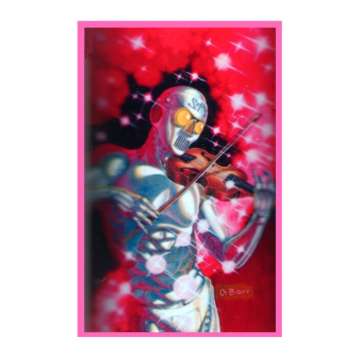
Alien Soundtracks — Chrome
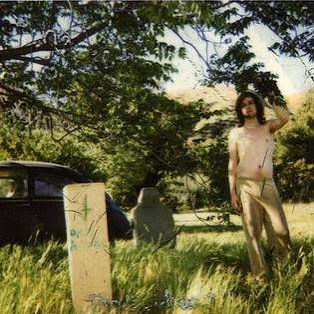
The Doldrums — Ariel Pink
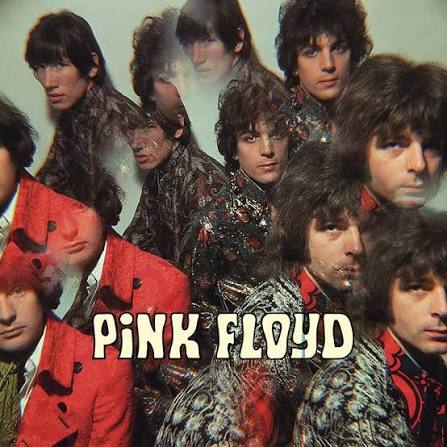
The Piper at the Gates of Dawn — Pink Floyd
“All of the great records have threads the music still hasn’t exhausted!”