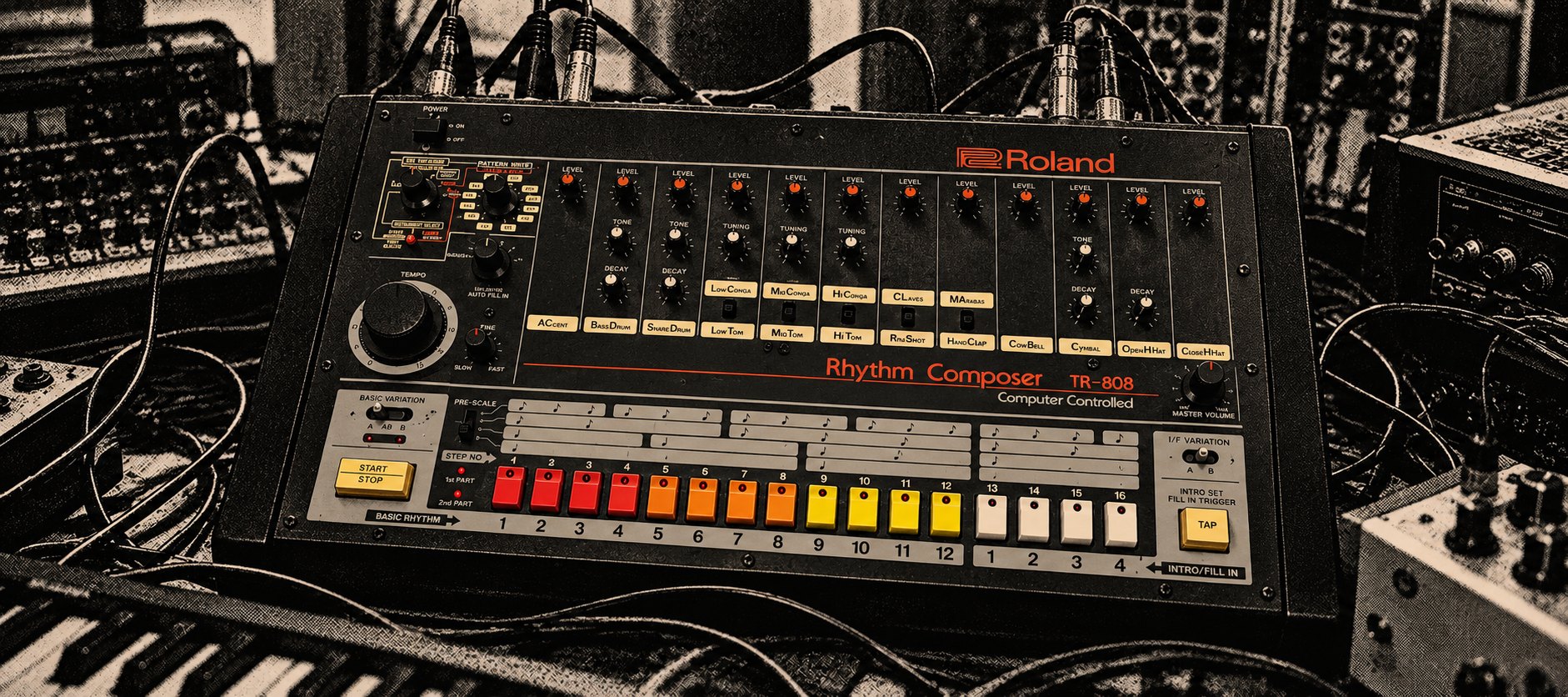
Roland wanted to build a drum machine capable of imitating a drum kit. It didn't succeed. Forty years later, we're still hearing the consequences.
I want a Roland TR-808. I don't need it.
It's worth starting there, because in 2026 wanting a machine that was only made between 1980 and 1983 is hard to justify. Any home computer does far more. There are excellent emulations, samples recorded from original units, reconstructions of its circuits and descendants that take up less space, cost less and cause fewer problems.
Even so, I want one. Not for the display case: to sit in front of it, press the sixteen buttons, program a pattern and fiddle with the controls until something happens.
For years I thought it was fetishism. It happens a lot to those of us who love these machines: we confuse the history of an object with wanting to own it. But the 808's story has something odd about it. The more you learn, the less it looks like the story of a machine that conquered the world by doing well what it was built to do.
Roland tried to build an electronic drum kit. The 808 didn't know how to play the drums.
A Drum Kit Without Drums
In the late seventies, a drum machine still felt a little like a household appliance. Many were meant to accompany organists: you chose a rhythm and a small, obedient band appeared inside the machine.
Roland had already begun to move away from that model with the 1978 CR-78 CompuRhythm, which let you program and store patterns. The TR-808, developed by a team led by chief engineer Tadao Kikumoto and launched in 1980, took the idea much further. It wasn't even called a drum machine. On the front panel it said Rhythm Composer.
You no longer chose the rhythm. You built it.
That left the problem of making it sound like a drum kit. Ikutaro Kakehashi, Roland's founder, had asked for a cheap machine with realistic sounds. But playing back digital recordings of real instruments required memory that was far too expensive, so everything had to come out of analog circuits. Kikumoto, decades later, tells it with a different nuance: his team was trying to synthesize how a drum kit should sound, not to copy one. Both versions can be true at once. The brief was to imitate; what came out of the lab wasn't.
They had to make a bass drum without recording a bass drum. A snare without a snare. Handclaps without hands.
The bass drum was born from a resonant circuit that produces a low-pitched oscillation whose frequency drops quickly; if you stretch out its decay, it stops being a thump and starts taking a bass's place. Cymbals and hi-hats have a metallic sheen nobody would mistake for real cymbals. The handclaps sound like a reconstruction made by someone who had only heard them described over the phone.
None of it fooled the ear, and thank goodness. If the 808 had imitated a drum kit well, it would be a museum curiosity today. What survived was exactly what it didn't know how to imitate.
The Parts That Weren't Good Enough
There is an episode in its making that seems to have been written after the fact to fit everything else.
Some of the 808's sounds (hi-hats, cymbals, the snare) are built from noise, and to generate it Roland used a batch of 2SC828 transistors that the manufacturer had rejected for failing to meet specifications. Kakehashi said he bought them on purpose. At the factory they were selected for the character of their noise and marked with a dot of paint.
They were the parts that weren't good enough, except for what Roland needed.
When semiconductor manufacturing improved and those defects stopped occurring, there was no way to restock them. Kakehashi pointed to it as one of the reasons the 808 went out of production in 1983. Not every unit even carries that transistor: the people who repair them have found other models fitted at the factory.
Over the years the story improved as it circulated and ended up crediting those transistors with the famous bass drum. That's not the case. The bass drum comes from a different circuit; the transistors affected the sounds made from noise. No need to dress it up.
The truth is already good enough: a component discarded for not behaving as it should ends up prized for exactly how it behaves. Forty years later, manufacturers and collectors are trying to reproduce, with precision, what failed quality control.
There are whole industries devoted to eliminating deviations. We musicians tend to go looking for them.
No More Pretending
The story of the 808 usually jumps straight to the United States, but before Detroit and New York something happened in Japan.
Yellow Magic Orchestra had spent a couple of years imagining music in which machines didn't have to apologize for being machines. Haruomi Hosono, Ryuichi Sakamoto and Yukihiro Takahashi worked with synthesizers, sequencers and drum machines with no interest in hiding the artifice. Roland rented them an 808 before it went on sale, and they used it live at the Budokan in 1980.
That same year Sakamoto used it on B-2 Unit, his solo album. Go back to “Riot in Lagos” and you understand why the machine found a home there.
You didn't have to close your eyes and imagine a drummer. That was the change.
For decades, progress in electronic instruments had consisted of resembling something else more and more closely. A synthesizer had to deliver convincing strings; a drum machine had to fool us for long enough for us to accept that it was a drum kit. With the 808 you could start asking a different question: what if it didn't have to resemble anything?
The Wrong Future
In the early eighties, the industry knew what the answer was. The future was digital samples.
Roger Linn's LM-1 came out the same year as the 808 and did exactly what the Roland couldn't: play back recordings of real drum kits. The LinnDrum followed in 1982. If a drum machine aimed to replace a drummer, the one that sounded most like a drummer was the better one. Hard to argue with that.
The TR-808 went out of production after about 12,000 units. It seemed to have lost.
But machines that stop representing the future undergo a very useful transformation: they get cheaper. 808s began to circulate second-hand and to fall into hands nobody had meant them for. Young musicians, producers, DJs. What some considered outdated, others could afford.
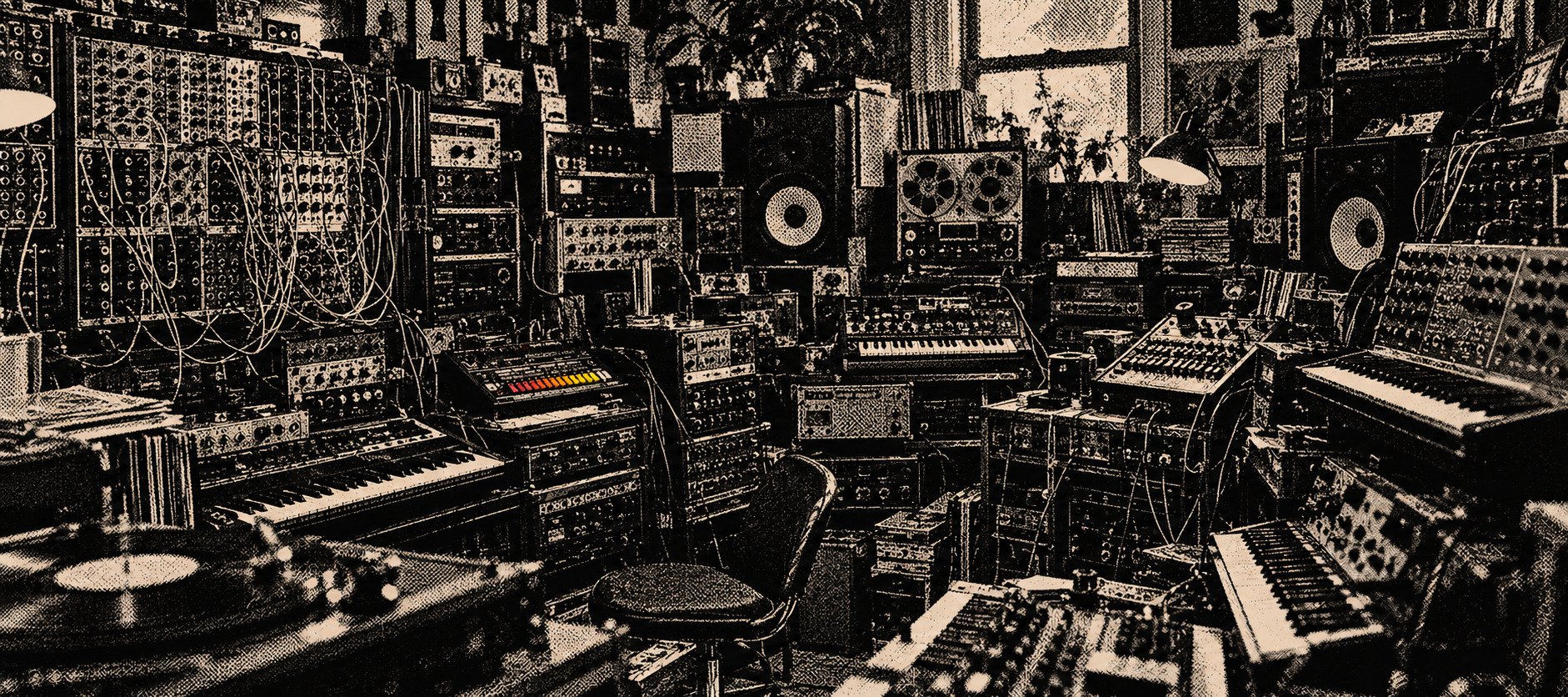
Obsolescence sometimes has democratizing effects that nobody plans. And the new owners had no interest in proving they could reproduce an acoustic drum kit. They wanted to make records.
The Second Life
In 1982, “Planet Rock” sounded as if several stories that shouldn't have crossed paths seemed to cross all at once: Afrika Bambaataa & Soulsonic Force, Arthur Baker, John Robie, Kraftwerk, the Bronx, European electronics, DJ culture, sound systems and a Japanese drum machine. Bambaataa, by the way, cited YMO and “Riot in Lagos” among his influences. The circle closed faster than it seems.
The 808 wasn't there to go unnoticed. The rhythm was electronic and wasn't ashamed of it.
That same year it appeared on Marvin Gaye's “Sexual Healing,” the first US hit with an 808, and showed that its strangeness didn't belong to a single scene. But perhaps the most revealing thing happens in Detroit.
Juan Atkins and Rick Davis started Cybotron with modest means. Atkins has said that the first recordings, “Alleys of Your Mind” and “Cosmic Raindance,” were made with a small Boss DR-55, and that by the time “Cosmic Cars” and “Clear” came along they already had an 808. Years later he would boast of having bought the first one in Michigan, when he was still in high school.
The nuance matters, because musical genealogies become suspiciously tidy once forty years have passed. Nobody switched on a TR-808 one afternoon in Detroit and invented techno. There were records crossing the Atlantic, late-night radio shows, cheap synthesizers, science fiction, funk, sequencers and a city whose relationship with machines weighed far more than any Roland catalog.
The 808 was one of those tools. And a tool doesn't decide what gets built with it.
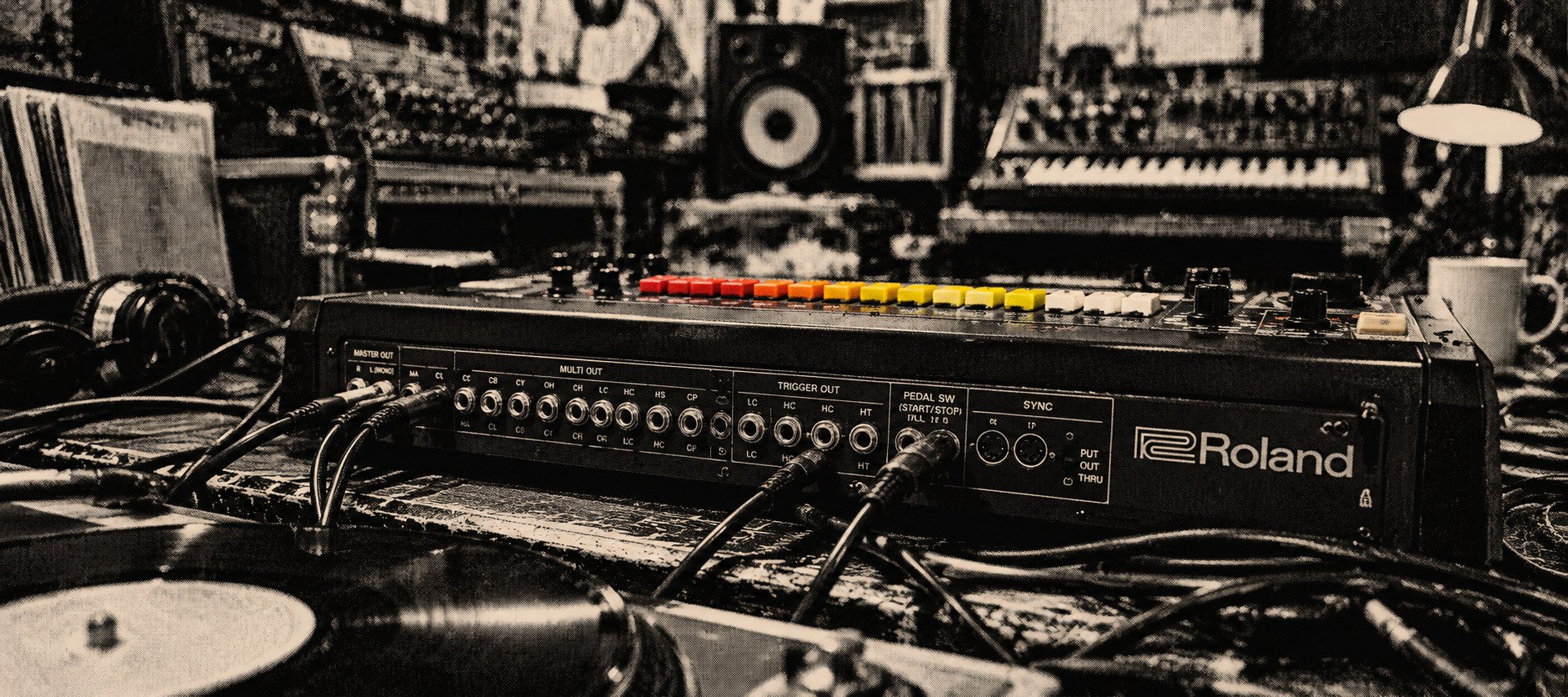
Roland could decide the bass drum circuit, the size of the casing, the connections on the back and what the manual said. It couldn't decide what the machine was going to mean.
When an 808 Stopped Being an 808
There is a strange moment in the life of some instruments: they stop needing the object that gave them their name.
In an interview from around that time, Richard D. James explained that on Selected Ambient Works 85-92 he had used modified 808 sounds. It fit the image of Aphex Twin: opened-up devices, altered circuits, machines forced to do things nobody had foreseen.
Then came the nuance. Those who have taken the album apart piece by piece maintain that many of those drum sounds come from a Roland R-8, a sample-based drum machine from 1989, with an expansion card that carried 808 sounds. He didn't own an 808 then. The sound was there; the machine wasn't.
It seems like a detail for gear obsessives, but it says something important: the 808 had started to exist independently of the 808.
It could be sampled, tuned, processed, copied, rebuilt. The bass drum could be stretched until it became a note, which is what James does on “Xtal” and “Ageispolis” by retuning it to use as a bassline. Hip-hop took that idea much further, and trap ended up making the descendant of that bass drum one of the dominant sounds of twenty-first-century pop. It is hard to imagine that was the plan in Osaka in 1980.
Today a producer can ask for “an 808” and not be talking about a Roland TR-808. They may be asking for a bass tone, a type of bass drum, a sample or a sound synthesized from scratch that has never gone through the original machine.
A catalog reference ended up becoming vocabulary. Not bad for an obsolete device.
Three Copies of “Spastik”
But when I think about all this, I don't think first of “Planet Rock,” or of Detroit, or even of that bass drum.
I think of “Spastik.”
I remember the first time I heard the Plastikman track and the feeling that it could go on indefinitely. There wasn't much to hold on to: percussion, repetition, tiny shifts. One hit changed a little and suddenly it seemed everything had changed.
In a 2013 talk at the Red Bull Music Academy, Richie Hawtin remembered the recording as a live take, from 1992 if his memory served. A 909, an 808 and probably some 707 as well. Nothing else: him improvising with three machines, moving faders, muting parts. He said that in some moments you can still hear him working the 808's controls.
Hands on controls. Tuning, decay, EQ. Few machines and few possibilities compared with any laptop today.
Maybe that's why it worked.
Now we can open hundreds of tracks, effects, synthesizers and automations without getting up from the chair. We have eliminated almost all the technical constraints that shaped a studio thirty years ago. I'm not sure that has eliminated the difficulty of deciding what to do.
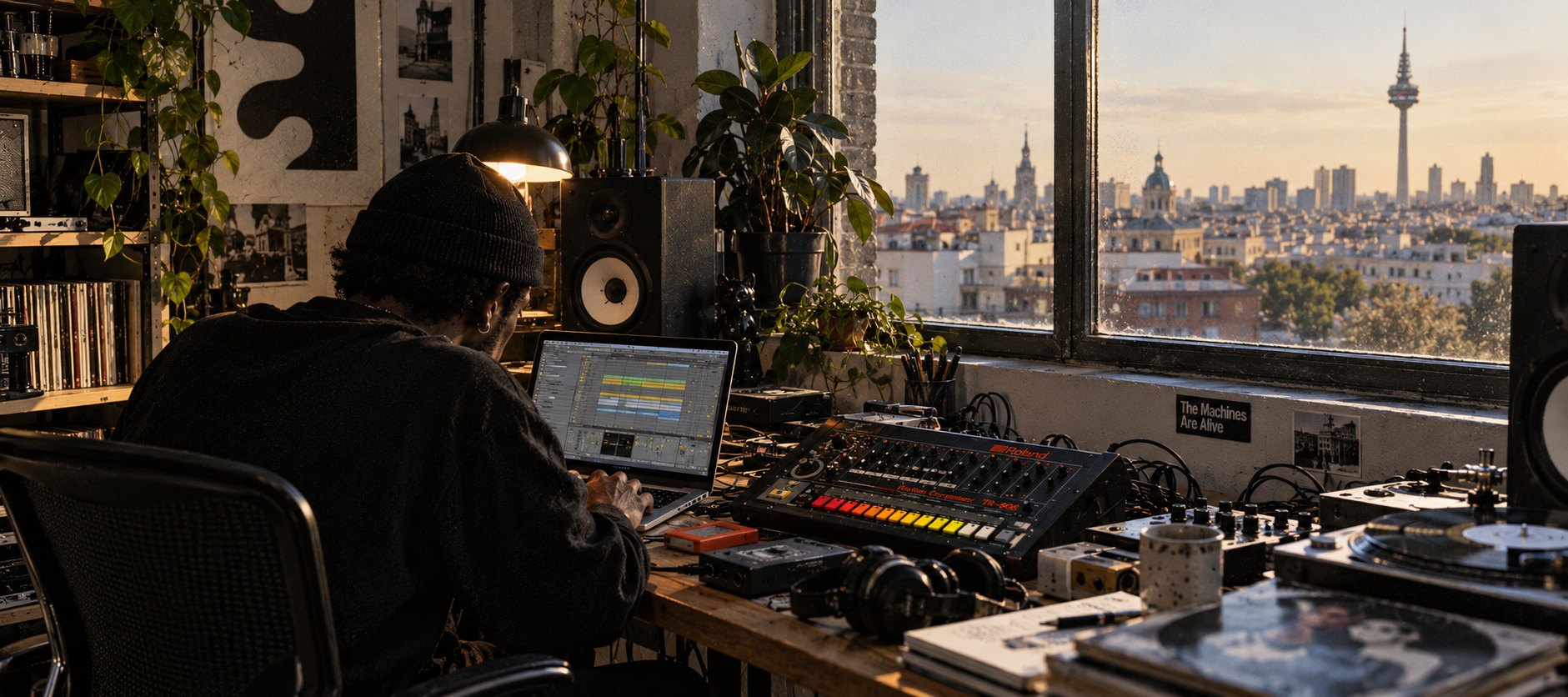
“Spastik” still fascinates me because it does a lot with very little. When there are hardly any elements, a tiny change stops being tiny.
I have three copies of “Spastik” on vinyl. There is no sensible reason to need three copies of “Spastik.” But there they are.
I suppose some records keep things that aren't in the grooves: a place, an age, the first listen, the person you were then. That is why, when I think of a TR-808, I still hear a rhythm that ended a long time ago.
I Want One
So I come back to the beginning.
I want a TR-808, and it is still a bad idea. It is big, it is old and an original unit costs an amount that is hard to defend. I don't need its circuits to have its sounds, and if I only wanted to make music there are far more practical alternatives.
But I don't want just its sounds.
I'm interested in sitting in front of a limited machine and finding out what I do with those limits. Sixteen buttons, a handful of instruments, a few controls. No opening another plugin because I'm not quite convinced by what I'm hearing.
And I'm interested in having in front of me an object whose history got completely away from what its builders intended.
We like to tell the story of technology as a succession of improvements: one machine solves a problem, another solves it better and the first disappears. Culture is much less orderly. It is full of guitarists in love with amplifiers that distorted when they shouldn't have. Of DJs who turned a device meant for playing records into an instrument. Of producers who made new music by cutting up old music on a sampler. Of voices warped by a program created to correct them.
And of a drum machine that never managed to sound like a drum kit, and that left enough space between what it was supposed to do and what it did for others to imagine the rest.
I still don't have one.
I have three copies of “Spastik.”