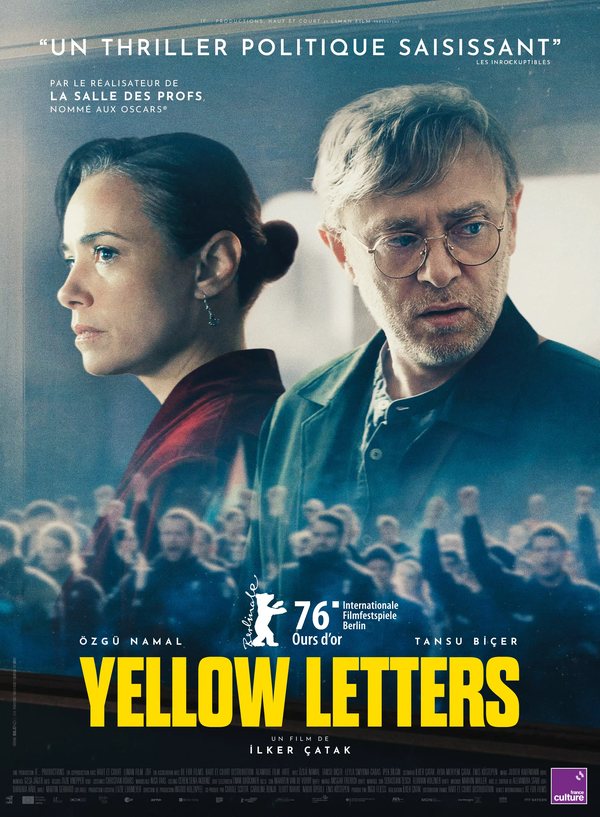
Yellow Letters
An intense political drama set in Erdoğan’s Turkey, with Berlin and Hamburg transformed into Ankara and Istanbul for the film. As in his previous feature, The Teachers’ Lounge, Çatak takes education as his starting point. At the centre is a married couple of artists: he is a writer and university professor, while she is a theatre actress. Both are threatened because of their political views and lose their jobs. This new situation creates conflict within the couple and leads us through the changing positions and development of the two characters.
The director focuses on the cost of freedom and of remaining true to one’s own moral principles, as the protagonists are forced to confront a new reality marked by precarious circumstances. Through this story, Çatak shows us corruption and censorship, and how people can be marginalised, excluded and silenced from social and professional life because of the way they think, their beliefs and their opinions. To give shape to the film, he contrasts the traditional family with the contemporary family, while also addressing Islam and highlighting the place occupied by Turkish women and the changes they are experiencing in contemporary society.
The story grows through its powerful dialogue and the intense, energetic conversations and disputes that run throughout the film. Interior shots gain more cinematic importance and interest than might initially seem apparent. It is a film that grows considerably in strength over the course of its running time and forces us to put ourselves in the position of one of the protagonists. The final sequence is an open-ended epilogue about freedom. Judge for yourselves.
Winner of the Golden Bear at the 2026 Berlinale; at the time of writing, any possible awards at the 2026 Seminci were still unknown.
José María Velasco Román
Director of the Festival Internacional de Cine de Cuéllar