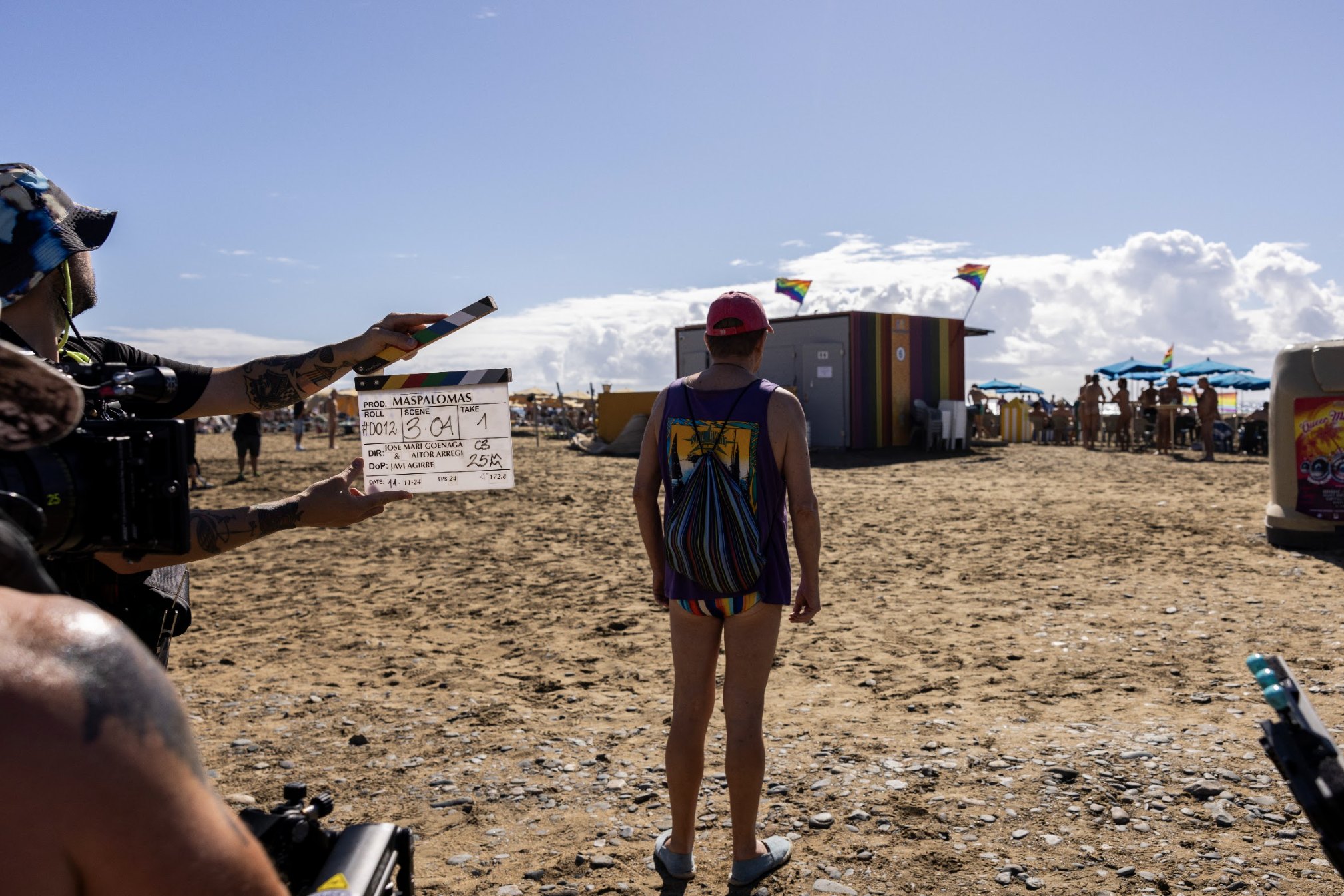
Aitor Arregi has spent more than two decades making films with Jose Mari Goenaga and Jon Garaño at Moriarti, swapping writing, directing and producing duties with them. After Maspalomas, and while Moriarti prepares to shoot a series announced by Movistar, we talked to him about authorship, actors, what a film teaches the people who make it, cynicism and what he still hopes to find when he sits down to watch one.
Listening to Arregi talk about more than two decades of working together, one difficulty emerges: reconstructing whose concern something originally was once a film ends up making it everyone's. It isn't necessarily a question of who had the idea — on Maspalomas, Arregi makes it clear that it was Jose Mari Goenaga who brought it — but of what happens afterwards, through years of writing, discussion and shared work.
Aitor Arregi has spoken of Moriarti's characters as people who live with fear, who are afraid of losing control. Jose Mari Goenaga has named confinement and the impossibility of showing oneself among his own obsessions. The two formulations make it possible to read differently a filmography in which hiding, or being unable to, has taken very different forms. A body exposed to other people's gaze in Handia. A man shut away for decades in La trinchera infinita. An invented identity that ends up trapping its owner in Marco. A 76-year-old man who, after living openly as a gay man in Gran Canaria, returns to a care home in Donostia and discovers that it is also possible to go back into a closet he believed he had left.
Arregi finds little distance between Goenaga's words and his own.
—Everyone lives these themes the way they live them, but we're making the same film. It's hours of talking and debating which themes we're going to touch before we start building it. You have to be very much in agreement with the themes the film touches; otherwise it would be hell.
Maspalomas was born partly out of feelings and experiences that Goenaga brought to the project, although Arregi insists that it is not a story based on the screenwriter's life. Confinement, the fear of showing oneself or the desire to control the image we project had been there long before. He finds them in La trinchera infinita, but also in Handia, Cristóbal Balenciaga or Marco. He even mentions a couple of projects not yet made in which those concerns reappear.
By that point, it is hard to tell where each of them began.
—Honestly, it's not easy for me to recognise what I was thinking at 23. In the end I don't remember what I was thinking at 23. I suppose each of us has brought our own obsessions and made the other's obsessions our own.
From the outside, it can be tempting to assign themes, sensibilities or decisions to each of the three. From the inside, the boundaries seem less clear.
—You can sort of know what one of them might like more, or how a theme obsesses him, but they're not separate obsessions. If they've worked and ended up on screen in a film, it's because all of us at Moriarti found them interesting.
«I suppose each of us has brought our own obsessions and made the other's obsessions our own.»
So we put something more concrete to him: to pick one decision in Maspalomas that he probably wouldn't have made if he had directed the film alone.
Arregi laughs.
—I'm not going to tell you.
Then he gives three reasons, and they're not the same one. He doesn't think it's appropriate. He doesn't remember. And the third:
—I'd have to think about it, and maybe I don't really feel like thinking about it, because I think that, in the end, these thoughts one can have only serve to inflate the ego. And inflating the ego really doesn't lead anywhere.
If one day they each make a film on their own, he says, we'll see.
—But I don't give it much thought either.
Fear of repeating yourself
On Maspalomas there was a specific problem with Vicente and his daughter Nerea. Several of their scenes took place during visits to the care home. Conversations, encounters, a man first in a wheelchair and later sitting on a bench. The relationship had to move forward, but the setup ran the risk of staying static.
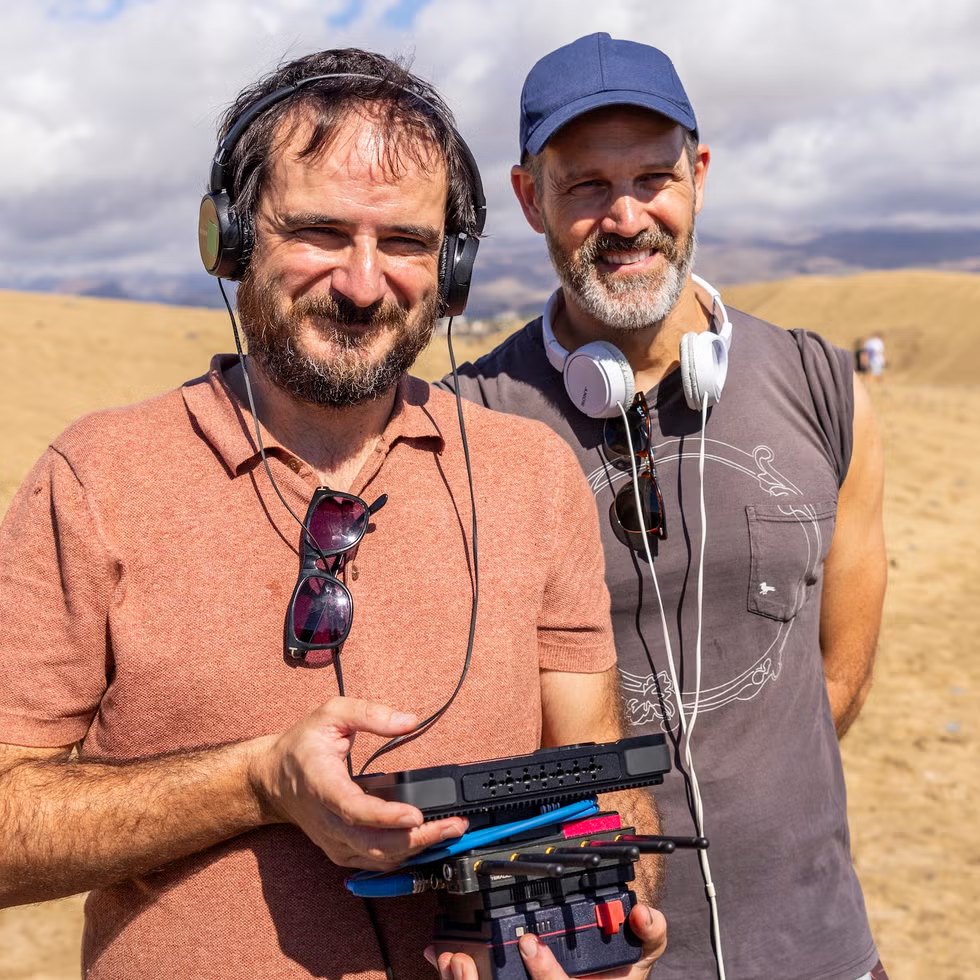
When Arregi talks about how they approached those sequences, he begins with two kinds of trust. The first lay in the text.
The script had been worked on by Goenaga, while Arregi and Garaño gave their opinion on each version. Before reaching the shoot, the three of them had discussed it and put it through successive revisions. The second kind of trust lay in the actors.
Moriarti rehearses, though not too much. There are table reads, conversations, the actors are listened to and the text can change if someone feels a line doesn't belong to the character.
—They're talented people and intelligent people.
But there was still a problem of mise-en-scène.
—Our concern was more about how to stop the sequences from being copies of one another.
Changing a location. Having the characters walk. Altering the situation of one scene in relation to the previous one.
—You're always living with that fear of repeating yourself within the film.
A reality you didn't know
Preparing a film, he says, forces you to learn about a world you didn't know.
—In the end it's almost two years of your life, sometimes even more. I think you learn a lot. I'm not saying you become a scholar, but you learn a lot about the world you're going to portray. You do a master's or a PhD. I'd say almost a PhD on the world that's going to appear in your film.
«One of the most beautiful things about cinema for me, both making it and watching it, is that a window opens up and you discover a reality, a world you didn't know.»
On Maspalomas that learning started practically from scratch. Arregi knew what Goenaga had told him and what he had read in the script, but he knew hardly anything about the place.
There he discovered the scale of Maspalomas as a gay tourist destination, the particularities of a climate that lets you swim practically all year round, the dunes and the cruising.
What struck him most was the variety.
—You see people of different ages, of a completely different profile. There's a very ignorant tendency, from a heterosexual point of view, to think that, for example, a gay man has very specific characteristics and doesn't go beyond them. If you pay even a little attention to the people around you, you see that's not the case, but if you go to Maspalomas it's an immense, infinite range of different profiles within what a gay man is.
That is what he meant when he told Cineuropa, in September 2025: «How simplistic we are when we haven't experienced something!».
—That's more what I meant: the closer you get to that reality, the more you realise you didn't know anything.
Asked whether, during that approach, he had discovered any prejudice of his own, Arregi makes a clarification. He admits that everyone has them, but he doesn't believe he approached Maspalomas from any particular one. He says he tried to approach that world with a «clean gaze», because it seemed best for the film and because he was personally interested in getting to know it that way.
—One of the most beautiful things about cinema for me, both making it and watching it, is that a window opens up and you discover a reality, a world you didn't know.
Then he moves from his own experience to the viewer's.
He talks about some of the reactions to the opening of Maspalomas: the cruising, the sex, the partying, an older man enjoying his sexuality.
—There are people who feel a bit attacked, but not by what they're actually seeing, because what they're seeing is sex, people having a good time and an older man having sex. It attacks them because their sentimental and visual education has kept them away from that, making them understand that it isn't normal.
The reaction may be to blame whoever decided to show it. To consider the scene unnecessary. To ask why it had to be seen.
—But maybe it's important that we put a mirror in front of you, that we put a mirror in front of ourselves and see a bit of what we are. Not what you say you are out in the street when you're talking with your mates or having a glass of wine somewhere pleasant, but how you react to this. Instead of blaming the person who put it in front of you, maybe you have to think: look, well, maybe I thought I had this under control and behind me, but I can see that I've got some issues here that I still have to work on.
Getting there, he admits, requires a willingness to examine oneself that isn't always there.
—For the most part we're not willing to do it, because we live on the surface of practically almost everything we touch. And that surface sometimes generates not only unfair judgements but also huge frustrations for each of us.
The two cynicisms
Arregi taught Audiovisual Communication for eleven years. He stopped six years ago. Those starting out now arrive with an access to films, interviews, schools and analysis that his generation didn't have, and that knowledge can end up in a form of cynicism. We asked him whether he recognises that risk in himself.
—Yes. I see that risk in myself, no doubt about it.
On the one hand there are creators who inevitably end up drawing on their own experience. Hence the abundance of films whose protagonists are writers, screenwriters or filmmakers.
—All Stephen King does is write about writers. It's normal.
«Not every human being in the world is a complete bastard.»
Another matter is the film that knows the images that came before it so well that it feels the need to point it out. A situation that decades ago could be depicted directly now comes with a comment, a wink or a reference that shows the film itself knows this has already been filmed before.
—There's a little touch of cynicism that, for me, is harmless, but sometimes it can make the film worse.
Arregi tries to keep the alarms switched on so as not to fall into it. But there's another cynicism that worries him much more.
—It's the cynicism of seeing everything through the prism of the merciless gaze.
He believes there's a certain intellectual bonus for stories that present a particularly negative or bleak view of the human condition. He mimics the reproach aimed at anyone who keeps a more positive outlook: if that's how you see the world, you're childish, someone who still believes in Disney and Peter Pan.
—That's a cynicism that, for me, is more dangerous. I don't subscribe to that at all.
He isn't calling for happy endings or laying down how other people's films should be. What he rejects is the idea that a merciless view of human beings provides greater depth in itself.
—Not every human being in the world is a complete bastard.
Whoever wants to make that kind of cinema, he adds, should go ahead.
—Cool. But that's not where I'm at.
Lying fallow
Right now the one who is, in Arregi's words, «lying fallow» is him. This time it's his turn to rest and prepare other stories for the future while his partners direct a series. That doesn't mean an absence of projects. There are fragments and ideas that never get developed because, when they're shared, they arouse little enthusiasm. Or for a simpler reason:
—We don't feel like it. There's no motivation.
The projects that have reached a more advanced stage are still alive. Arregi uses a cycling image to describe them: they're still «riding the Tour», competing with one another to find out which make it to the finish line and which end up abandoning.
He doesn't yet know what the next film will be.
Setting the counter back to zero
—I think I'm asking of cinema what I always have. That it tells me a good story. That it interests me, that it makes me understand this world a little bit more, that it entertains me, that it makes me understand myself a little bit more.
It also allows him an impossible conversation: meeting someone who died fifty years ago and left behind a film made in Japan, the United States or France.
—That's what I ask of it. Hardly anything, really.
As a child he perhaps hoped more intensely that a film would amaze him. Something of that expectation remains.
—I think there's something inside me that asks for some film to amaze me.
At this stage he still enjoys the moment before knowing what's going to happen.
—For me it's a real pleasure to keep sitting down in a cinema seat, in a cinema seat if possible, and if not on my sofa, set the counter back to zero and start watching the film.
He places it among the great pleasures of his life, though he is quick to point out, laughing, that there are a few above it. For Arregi, cinema does have privileged access to people, but not exclusively: the other art forms have it too. It may be one of the most complete arts because of the number of disciplines it brings together, but it doesn't follow that it goes further.
«That's what I ask of it. Hardly anything, really.»
A painting can contain something a film can't reach. So can a song, a book or a photograph. It all depends, he says, on «where you've got your antennae pointed».
—Cinema is, without a doubt, the art form I like most. But it's the child of all of them. All the disciplines that came before cinema are the mothers and fathers of cinema. I'm not going to put the son or the daughter ahead of the others.
Three records
Before finishing, we asked him for three records that would explain something about him. Not necessarily his favourites or the best ones. Three titles that might portray him.
—I'm not a music buff.
He says it with neither pride nor shame. He would have liked to know more about music, but he doesn't think that's going to change at this point.
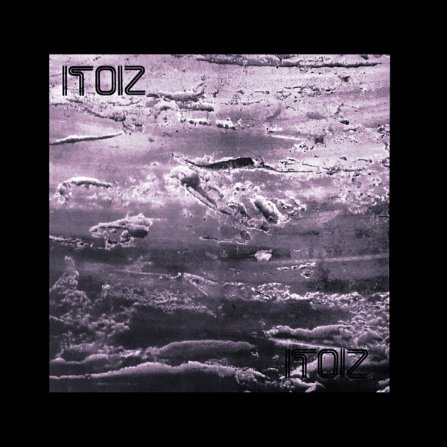
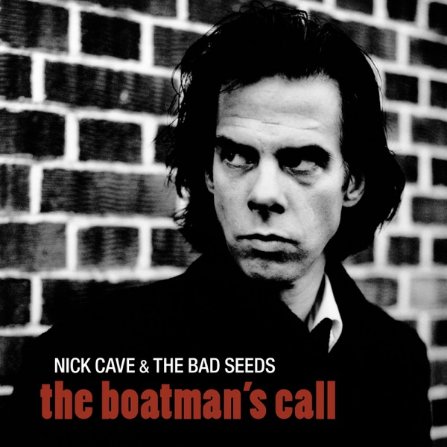
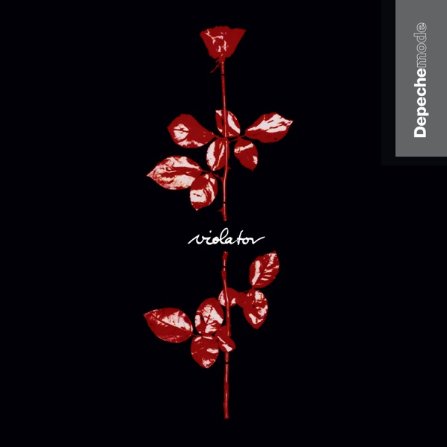
He starts with Itoiz, whom he still listens to «with real devotion». Then comes Nick Cave and the Bad Seeds, although he can't pick a specific record. Depeche Mode too, whom he saw recently in concert and whose live show left him ecstatic.
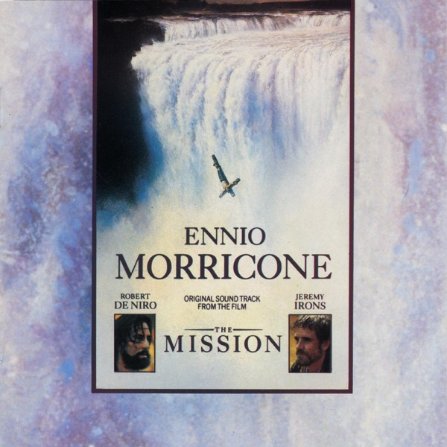
And then the soundtracks appear. John Williams. Ennio Morricone.
—To me they're from another planet.