Jamaican Dub: The Laboratory and the Jungle
From a Kingston studio to a sports hall in Cardiff, a festival in Móstoles, and Berlin techno.
My first real contact with dub happened in Cardiff, in the mid-nineties, in a setting rather less exotic than you'd expect for a musical revelation: a municipal sports hall.
I was living in the city then, starting to frequent gigs and parties I knew almost nothing about before walking through the door. One night I ended up at the STAR Centre in Tremorfa, watching Zion Train. I knew reggae and had listened to dub, but this belonged to another category entirely. Until then I'd understood that music as something that happened inside a record. That night I discovered it could also happen inside a body.

The STAR Centre had the unmistakable look of a council facility: a big sports court, fluorescent lights, court lines painted on the floor, a 'No Smoking' sign nobody seemed inclined to enforce that night. At one end stood a wall of speakers. I don't remember ever having seen so many stacked together. Cabinets piled on top of each other, cables, amplifiers, smoke. In front of it, a crowd dancing where a few hours earlier someone had probably been playing basketball.
And then the bass arrived.
It wasn't simply low. It was a physical presence. The air seemed to move every time it hit. You felt it in your chest, in your stomach, even in your clothes. The records I'd heard up to then reproduced sounds; this system seemed to temporarily alter the architecture of the building.
But what I remember most clearly isn't a song.
I couldn't even reconstruct the gig in the right order now. I remember fragments: a trumpet cutting through the smoke — real brass over the machines, something that sounded ancient and futuristic at once — echoes that seemed to carry on after their source had vanished, the coloured court lines appearing between people's feet, that wall of speakers working like an absurd machine whose only function seemed to be moving enormous quantities of air.
That night I knew nothing about where any of it came from.
I only knew I was on a sports court in Cardiff, under fluorescent lights, watching Zion Train in front of a wall of speakers.
And that dub, suddenly, had stopped being something you listened to.
What I felt that night in a Cardiff sports hall was, without my knowing it, the late result of a series of decisions made twenty years earlier and eight thousand kilometres to the west, in a house in Kingston where a radio technician named Osbourne Ruddock spent much of his time taking machines apart to work out how they functioned.
Kingston, Late Sixties
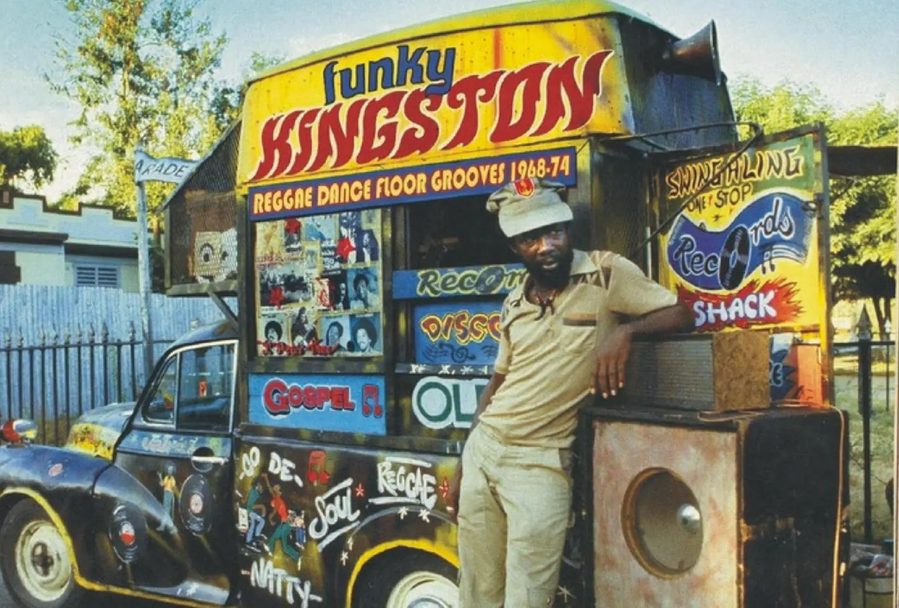
By the late sixties, much of Jamaican popular music lived outside concert halls. Sound systems set up their rigs in yards, vacant lots and open spaces around Kingston and competed over something fairly basic: sounding better than the system next door, and above all, having records the system next door didn't have. A selector chose the music, a deejay improvised over it, and the crowd gathered around the speakers. Exclusivity could decide a night.
That economy produced one of the strangest objects in the history of popular music: the dubplate. An acetate cut in a handful of copies — sometimes just one — fragile and doomed to wear out after repeated plays, which let a sound system hold, for a while, a recording nobody else could spin. Then came the versions: mixes that pulled the vocal out, partly or entirely, and left the riddim exposed for the deejay to work over. What had started as a competitive edge produced a consequence rather harder to calculate: a song could stop being a fixed thing.
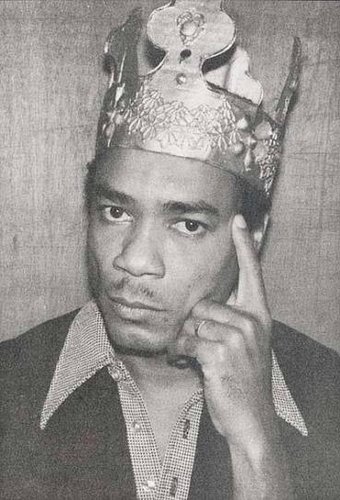
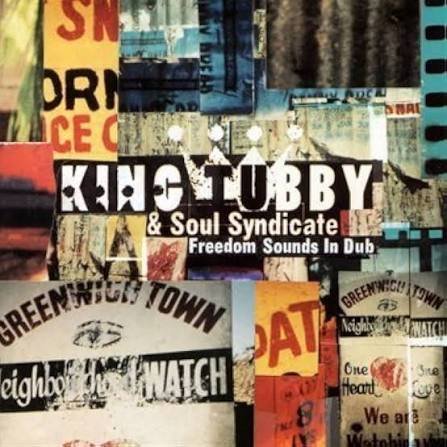
In the middle of that frequency war worked Osbourne Ruddock, known as King Tubby. He hadn't come from a conservatory, nor arrived at music as an instrumentalist. He repaired radios and televisions, built amplifiers and transformers, and knew electronics through probably the least romantic route available: when something broke, you had to get it working again.
In his studio on Dromilly Avenue he carried that same relationship with machines over to the tapes arriving from other studios.
You can hear the procedure at work on 'King Tubby Meets Rockers Uptown.' The original recording was 'Baby I Love You So,' sung by Jacob Miller and produced by Augustus Pablo. The sessions had been cut at Randy's; Pablo then took the tapes to Tubby to mix.
What happens next lasts under three minutes.
Pablo's melodica appears and disappears. Miller's voice surfaces for a few seconds and sinks back down. Bass and drums remain while guitars and instrumental fragments drift in and out of the mix. Some sounds vanish but leave behind a trail of echo that takes several seconds to die out. Tubby doesn't seem to be mixing a song so much as testing how much he can take away before it stops being recognisable.
And he discovers he can take away quite a lot.
That's perhaps the most unsettling detail about hearing the piece today. The emptiness doesn't interrupt the music: it starts to become part of it. When the voice disappears, the ear keeps waiting for it; when a note dies out, the echo holds, for a few seconds, the memory of something no longer there. The studio has stopped being simply the place where a performance gets recorded. Now it can step in afterwards, take the performance apart and rearrange its remains.
It's worth resisting the temptation to turn all this into too comfortable a parable about poverty producing genius. Kingston had extraordinary musicians, professional studios and technicians who knew exactly what they were doing. But it also had economic constraints, a singles industry that recycled riddims, modified equipment, and a sound system culture that constantly demanded new material. The innovation didn't appear despite those conditions, nor can it be explained solely by them. It appeared working inside them.
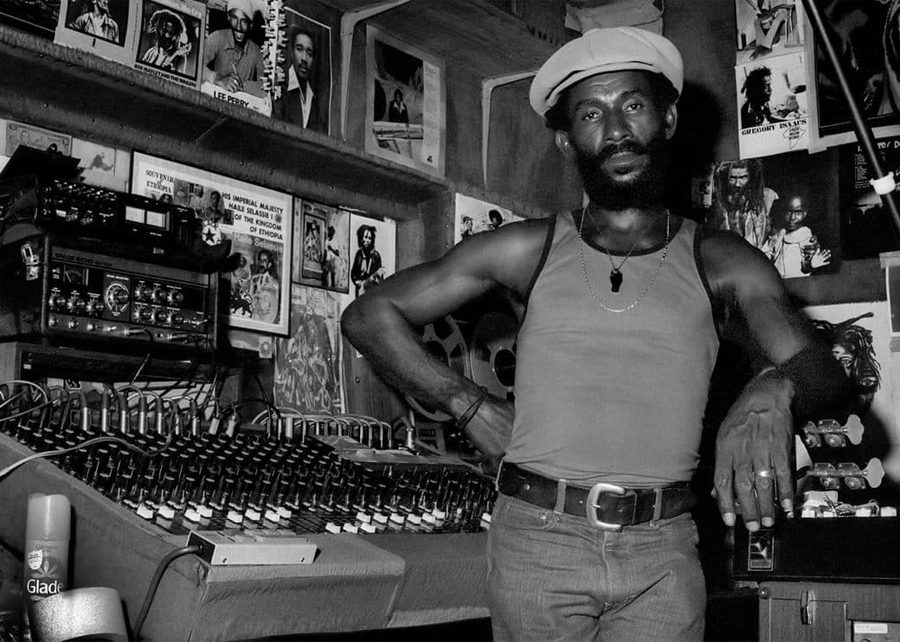
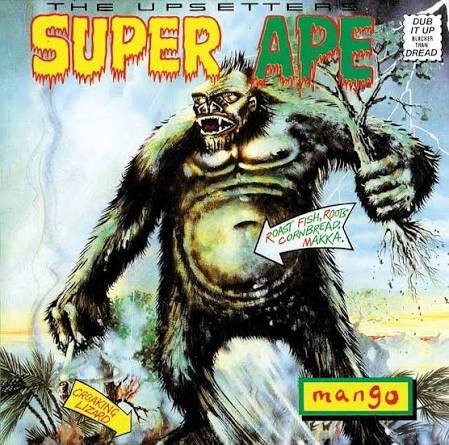
Tubby wasn't alone, either. While he was steering the mix toward a kind of engineering of disappearance, Lee "Scratch" Perry was building, at Black Ark, another form of strangeness: overdubs, saturation, noise, effects, voices and sounds that seemed to have entered the studio through a door nobody remembered leaving open. On records like Super Ape, dub was starting to look less like a specific technique than a question different Jamaican producers were each trying to answer in their own way.
What could be done with a recording once it had already been recorded?
The answer turned out to matter far more than the original problem probably demanded.
Once it was discovered that a voice could disappear and go on being present only in the echo it left behind, a record no longer had to be considered finished.
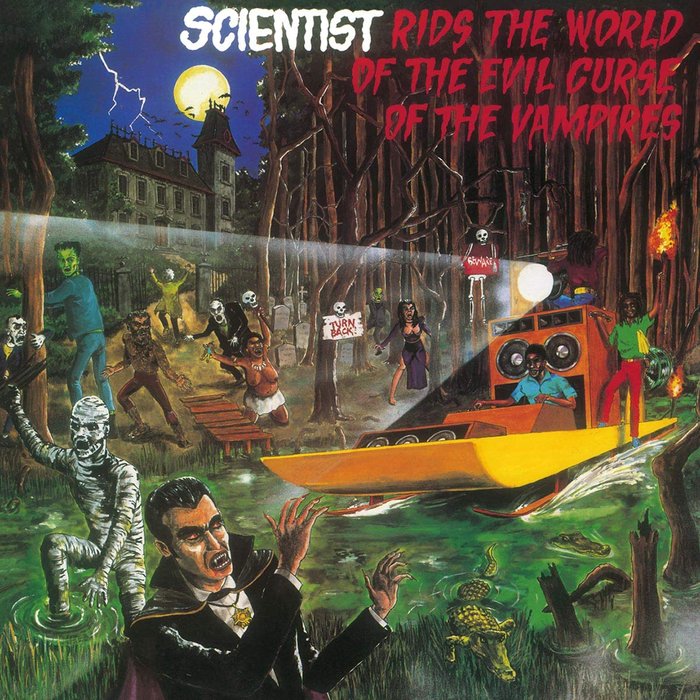
There was an explanation too good to let go of. King Tubby was the scientist; Lee "Scratch" Perry, the shaman.
The first repaired televisions, built amplifiers, and seemed to approach a song the way someone opens up a broken radio on a table to find out which part has stopped working. The second turned Black Ark into a place where the borders between technique, superstition and spectacle became considerably harder to draw. Perry talked to machines, attributed powers to objects and words, and cultivated around the studio a mythology in which smoke, spirits and electricity seemed to belong to the same circuit. He made it plain himself when he sorted the people working around him: there were "scientists" and there were "magicians." The ones who operated computers and knobs, he called scientists. Nobody ever needed to ask which side he put himself on.
The records themselves seemed to confirm the theory. On 'King Tubby Meets Rockers Uptown,' the music organises itself around what disappears. Tubby pulls out voices and instruments, opens up gaps, and lets the echo trace, for a few seconds, the outline of whatever he's just erased. On Super Ape, Perry does exactly the opposite. Percussion, horns, voices, noise, reverb and instrumental fragments pile up into a damp, saturated mass in which it's hard to tell where the studio ends and the song begins. If Tubby opens up space, Perry occupies it. One works with disappearance; the other, with proliferation.
Scientist and shaman. Laboratory and jungle. The explanation worked beautifully.
Maybe too well.
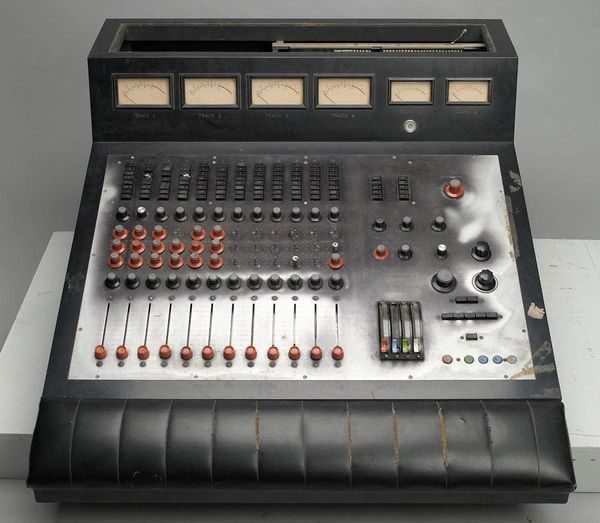
Because to build that jungle, Perry had a four-track tape recorder. Every time he needed to bring in new elements he had to combine earlier recordings, bounce them down and free up room to keep working. Max Romeo, who sang for him, remembered how he managed to multiply those four tracks: he got "a hundred more tracks in and out of there using stones, water, kitchen utensils." Bouncing let him multiply the machine's possibilities, but it came at a price: decisions began stacking on top of each other, and each new bounce made it harder to go back to an earlier point. The music that looked like the more chaotic of the two therefore depended on an extraordinary ability to foresee what might happen several layers later. Perry could dress his work up in magic, but the miracle needed planning.
With Tubby something similar happened in the opposite direction. All that electronic precision fed into an act that had rather little of the laboratory about it. Without automation, a dub mix was built by hand while the tape ran: pulling one fader down, opening another, adjusting the EQ, sending a signal to the echo for an instant and pulling it back before the next one arrived. The console didn't just register decisions made in advance. It had to be performed.
That turned every mix into a small performance. The man who had got there by repairing circuits ended up using a mixing desk as an instrument; the supposed shaman needed to know the limits of a four-track machine intimately in order to make it seem as if it had none.
The explanation, then, wasn't entirely false. That was exactly the problem: it was too good.
Tubby and Perry did work in different ways. Their records prove it. But maybe the difference wasn't between reason and magic, or between the engineer and the visionary. It had to be looked for somewhere much more concrete: in what each of them decided to do once they had a tape in front of them.
Tubby took away. Perry piled on.
There's a moment on 'Declaration of Dub' — included on Dub From the Roots (1975) — where the song buckles. The main melody vanishes without warning, no fade, no transition: the arrangement is left decapitated and only a cluster of backing vocals survives, suspended over the rhythm, as if someone had kept singing after the rest of the band had already left. The ear instinctively hunts for the lost melody, and finds instead those voices floating over bass and drums, with nothing in front of them to hold them up. The last thing left of the arrangement isn't a clean ending but its echo tail, bouncing against a space that no longer exists. By taking information away, Osbourne Ruddock got us to hear more.
That vanishing trick was performed strictly live. As the tape ran across the heads, the Dromilly Avenue desk stopped being a mere recording surface and became another instrument. With no automation and no digital cut buttons, a dub mix was a piece of physical choreography: to make an entire section disappear, Ruddock would slam the faders down with the heel of his hand in a fraction of a second. His faders, moreover, weren't stock: he'd modified them himself so they'd slide without the mechanical snag of the cut switches his competitors used, and that missing friction was already part of the sound.
He soon found that clearing out the frame wasn't enough: he could also work on the survivors. For that he used his desk's high-pass filter, an Altec 9069B, a passive unit with ten fixed positions, not a continuous knob. Turning it on a guitar or a scrap of arrangement he'd decided to spare, the sound lost body all at once and took on a telephone texture, distant and metallic — and the change was never a smooth slide but a jump between fixed positions, mechanical click included. It was his signature: turning what the unit couldn't disguise into a musical event. That same logic can still be heard years later on the sessions that would eventually come out as King of Dub, also mixed at his studio.
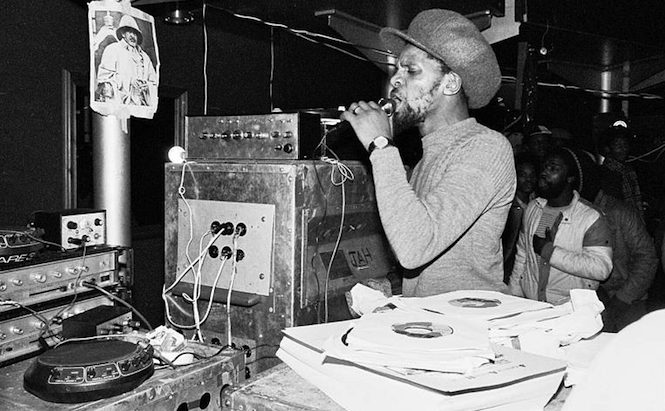
That systematic emptying-out found its ultimate purpose once it left the studio and went back to the open ground. At the sound systems, where bass bins reached the size of a wardrobe and volume was measured by the actual displacement of air, stripping out the melodic instruments produced a colossal effect. When almost everything else disappeared, the bass stopped competing with the song. It started taking over everything, vibrating in the crowd's clothes and stomachs.
What had started as a shrewd way of squeezing the resources out of a second-hand mixing desk in a Kingston suburb soon proved to be no isolated whim of one extraordinary individual. In the small room on Dromilly Avenue, learning worked like an open-door workshop, not a school. Lloyd James — the future King Jammy — arrived in 1976 already knowing how to build his own amplifiers and inherited the console left vacant by Philip Smart, the house's first apprentice. A couple of years later came Hopeton Brown, a teenager who repaired radios, whom Tubby received with suspicion: too young, too much weed, too many strange ideas. Nobody gave him a lesson; they gave him the keys. "Nobody taught me to record either, I had access to the studio and it worked," he'd say once he'd become Scientist. His edge, he claimed, wasn't talent but the inheritance of a television-repairman father: he had "X-ray vision" of the console. What had been born as a material restriction had turned into a technical solution, then an aesthetic language, and finally a transmissible method. King Tubby had found a way to make music by taking things away. What truly mattered happened once others learned how to do it.
If King Tubby's room ran on the clean order of a repair shop, Lee "Scratch" Perry's Black Ark studio worked like a tropical organism where everything tended toward proliferation and tangle. In the yard at Washington Gardens, dub abandoned the geometry of stripping-down to become a strategy of accumulation. Perry didn't have unlimited space: his four-track TEAC recorder was exactly the same limitation that had forced Tubby to invent emptiness. When he needed to add one more layer, he'd mix three tracks down to one and free up room to keep recording on top — a bounce with no way back: once fused, those three tracks could never be separated again. Each new pass dragged along the distortion and compression of the one before, not as a sought-after effect but as the physical residue of working inside a machine built for scarcity. If Tubby invented emptiness, Perry invented thickness.
Maybe that was the ghetto's real psychedelia: not a mental escape route but a way of physically widening the space of the yard through low frequencies. The Smithsonian itself would later recognise, in that very bounce, something more interesting than the myth: the invention of self-contained, reusable blocks of sound, able to be dropped in at any point in a song — the conceptual seed of the sampler, a decade before the machine existed. Rock psychedelia went looking for other worlds; dub, as Perry understood it, physically altered this one. That was the psychedelia I danced without knowing it twenty years later, with no acid and no incense involved: not an expansion of the mind but its momentary displacement, by way of the bass. When the air moves like that, you don't need to believe in anything to alter perception.
London, 1955–1980
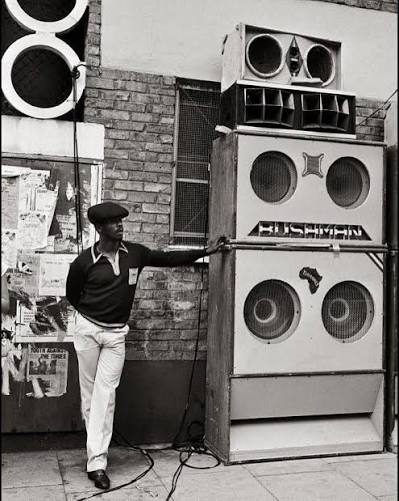
None of this needed to wait for the eighties to cross the Atlantic. In 1955, a Jamaican stowaway named Vincent George Forbes set up, in Ladbroke Grove, the first Jamaican-style sound system on British soil, christened Duke Vin the Tickler's — twenty-five years before On-U Sound was even born. The racism of the Windrush years had pushed these sessions into basements and private front rooms, the same "blues parties" that, two generations later, would still be deciding where and how that music could be heard outside Jamaica. The relationship between Kingston and London wasn't the late export of one isolated genius: it had already been running as a continuous circuit for twenty-five years.
Among those who learned to use that grammar outside Jamaica, Adrian Sherwood took the deformation especially far. He didn't get there through Perry but through another sound-system veteran: the deejay Prince Far-I, with whom he toured the UK in the late seventies, and from whose Cry Tuff Dub Encounter Chapter III he took the name of his own alias, Dub Syndicate. Founder of the On-U Sound label, Sherwood applied that grammar to the urban collapse of eighties England — and the proof needs no adjectives: he produced records by The Cure, Living Colour, Depeche Mode, Simply Red and Cabaret Voltaire.
The clearest proof of how far that deformation went doesn't need interpreting: it can be heard. In 1987, Perry walked, literally, into Sherwood's studio. Time Boom X De Devil Dead, co-produced by the two of them and recorded with the old guard of the Roots Radics — Flabba Holt on bass, Style Scott on drums — is the one exact point on the map where the laboratory and the jungle share the same room. Critics at the time already described the result without needing this article's help: a band that sounded harder and rougher than the Upsetters themselves, over which Perry kept singing exactly as he always had. The contrast that opened this section — geometry against proliferation — played out inside a single record.
Twenty years after Perry had been dismantling four-track tapes in a house in Kingston, that same logic of contagion no longer even needed a Jamaican context to spread. I was, without knowing it, one of its hosts.
Móstoles, May 1997
In May 1997, I ran into that same force again head-on, but in a radically different setting: Parque El Soto in Móstoles, during the second open-air edition of the Festimad festival. There were no more council-hall fluorescent lights or Welsh rain; there was a crushing heat, dust hanging in the air, and a crowd that completely overwhelmed the security arrangements of the day.
I was there, like most people, waiting for the electronic-punk steamroller The Prodigy were promising. But in the dead time between sets, while the crowd packed in front of the main stage, something unexpected happened. The sound engineer didn't put on background music to fill the wait. What the festival rig started spitting out was a seismic frequency, a bass sound so dense that the dust hanging in the air seemed to vibrate with it.
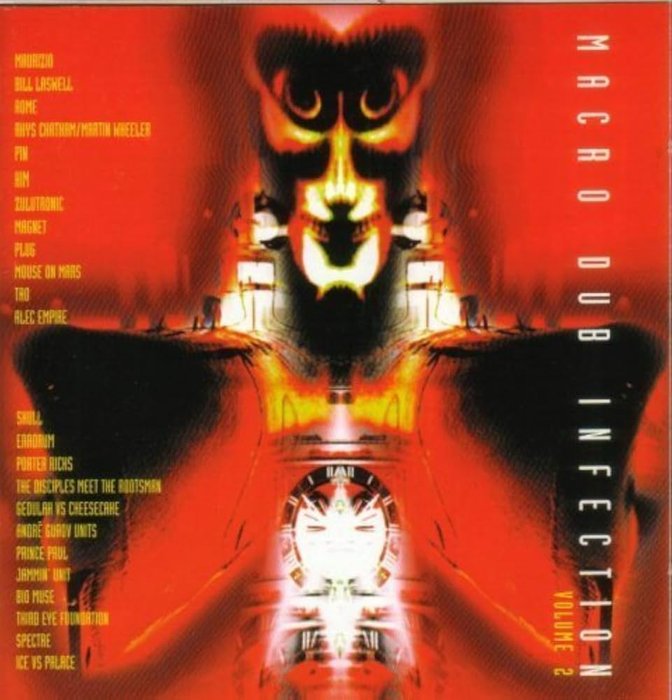
Years of record-hunting later led me to discover what it had been: the compilation Macro Dub Infection Volume 2, released by Virgin shortly before.
Hearing the tracks on that record — where Maurizio's icy minimalism sat alongside Bill Laswell's dense mysticism — in the middle of a huge alternative-rock festival in Spain was disorienting. If years earlier I'd understood that dub was experienced with the body, at Festimad I understood you no longer had to go looking for it: it travelled on its own, like a virus, hidden inside music that seemed to be about something else entirely. What King Tubby or Lee "Scratch" Perry had invented by dismantling tapes in the seventies had already spent twenty years infecting music that had nothing to do with Jamaica.
The bass had stopped being something you inhabited. It had turned infectious.
What I didn't know that afternoon in Móstoles was that the very record playing in the background already pointed toward the end of this story: among its tracks were Mouse on Mars, the same act that years later would co-produce Perry's final album, and someone called Maurizio, behind whom hid the Berliner Moritz von Oswald.
Dub had been carrying this paradox since Dromilly Avenue without anyone naming it: echo and reverb weren't ornaments but the exact measure of an absence, and that absence — the voice no longer there, the instrument that has vanished — loaded the music with an emotion no explicit lyric could have achieved. Techniques born of one specific material constraint had outlived that constraint and were starting to turn up in music that shared neither its geography nor its circumstances.
What's left of the language of scarcity once it's transplanted into the heart of technological abundance?
The answer was waiting in Berlin.
Berlin, Early Nineties
In the early nineties, the technical problem in Berlin was almost the opposite of the one King Tubby had faced twenty years earlier in Kingston. Machines no longer forced you to work with four tracks or fuse several recordings to free up room. Samplers and sequencers let you repeat, store and rearrange sound with a precision the Jamaican studios of the seventies had never known. In the middle of all these new possibilities, Mark Ernestus and Moritz von Oswald decided to operate in the opposite direction.
Ernestus had founded the Hard Wax record shop; von Oswald had spent years working in electronic music. Together, under names like Basic Channel and Maurizio, they found an unlikely point of contact between two musics separated by thousands of miles: the techno arriving from Detroit and that old Jamaican intuition that a mixing desk could be used to take a recording apart. They didn't start from a prior conceptual manifesto. They worked directly on the sound, testing how far a radical discipline of restraint could go once applied to techno's new tools.
The result can be heard with particular clarity on 'M5,' released under the Maurizio alias in 1995. The record opens with the machinelike pulse of a four-to-the-floor techno kick, but a single synth chord soon appears that never progresses. No new notes, no melodic development. That chord loops over and over, but it never seems to sound quite the same: sometimes it comes through clearly, other times it sinks into the mix, other times it drags a trail of grey hiss that fills the space between kick drum hits. The percussion comes and goes while the reverb keeps continuously reshaping the depth of the scene.
The elements don't move toward anywhere. They change distance.
There was the old Kingston intuition at work inside a completely different machine. On 'Declaration of Dub,' Tubby had got the ear to pay attention to a melody precisely by making it disappear. On 'M5,' twenty years later, Maurizio did something similar with repetition. The new machines could reproduce an event over and over with precision; von Oswald and Ernestus used the studio to make sure that repetition never quite felt identical. The loop stayed. What changed was the space around it.
The difference was fundamental. Tubby had worked inside specific material constraints. Perry had made four tracks feel like many more. In Berlin, those constraints were no longer necessary. They could be chosen.
Scarcity had become an aesthetic.
That's why reducing Basic Channel to dub's influence on techno falls short. What had survived the journey wasn't simply a deep bass, an echo, or a particular way of using reverb. It was an idea about how music could be built: repeat instead of develop, take away instead of add, let the studio keep reshaping the relationship between the few elements that remained. As the musicologist Michael Veal has written, the sonic and formal concepts dub had developed while working inside specific material conditions would end up functioning as compositional models well into the digital age.
But von Oswald and Ernestus could still take away one more thing.
The voice.
On much of that material, the human presence seemed to have withdrawn almost entirely. What remained were machines, pulses, noise, depth. Dub had travelled so far from the Jamaican song that its starting point could be hard to recognise.
And then they made the return journey.
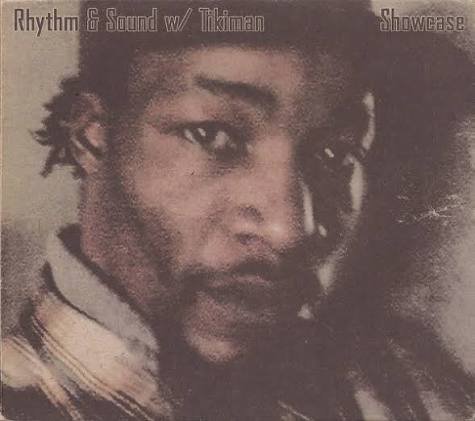
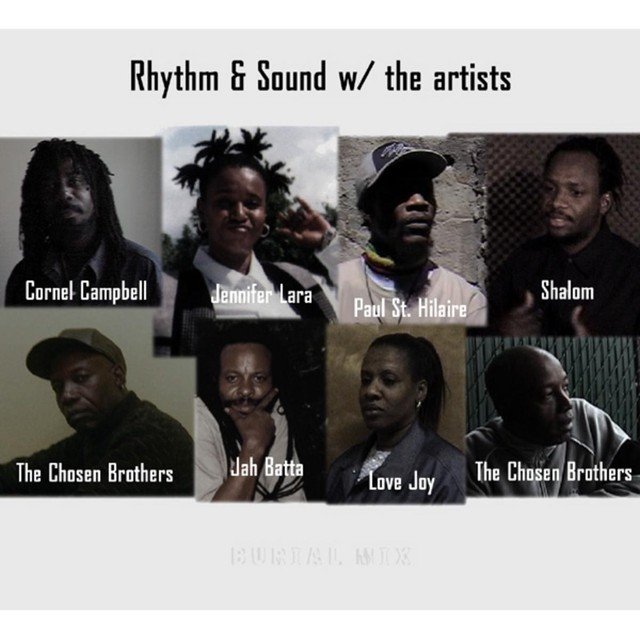
In the late nineties, under the name Rhythm & Sound, von Oswald and Ernestus slowed the pulse and pushed that reduction even further. Bass, percussion, echo and silence were enough to build pieces that seemed to hang suspended in the air. But just when dub seemed to have been stripped down to its most elemental structure, a voice returned to the centre of the mix.
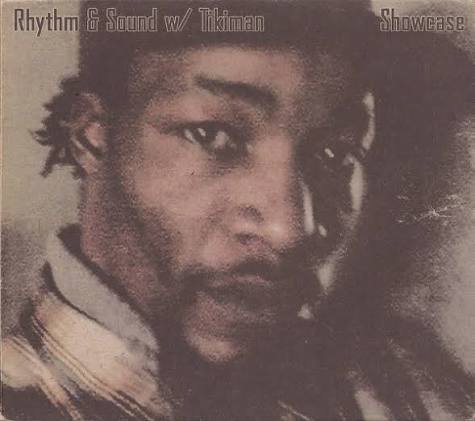
It was Paul St. Hilaire's, born in Grand Bay, on the small Caribbean island of Dominica, settled in Berlin for years by then. On recordings like 'Music A Fe Rule,' his unhurried phrasing didn't impose itself on the music the way a traditional vocal track would. It moved in and out of it, left phrases hanging, and let the echo go on speaking after the voice had disappeared.
After twenty years of travel, one of dub's oldest structures resurfaced inside the very technology that seemed to have made it unnecessary: song and version, presence and absence, a voice and the space left over once that voice withdrew.
Kingston had taught Berlin that a recording could be taken apart. Berlin had turned that procedure into an aesthetic choice and, after pushing it almost to abstraction, had brought a voice from the Caribbean back inside the machine.
It would still take me a few more years to hear how that whole journey sounded.
Barcelona, May 2004
Nine years after the Welsh revelation, dub was no longer a secret code or a virus hiding in the gaps of a rock festival. In May 2004, at Barcelona's Poble Espanyol — the last edition of Primavera Sound before its move to the Fòrum, that fake village built for tourists which, for once, was good for something real — I went looking for it directly.
I saw the reunited Pixies and Wilco, like almost everyone else that year. But my real appointment, the only one I'd planned in advance, was elsewhere: the second stage, Rhythm & Sound with Tikiman.
I found it stripped of any festival grandeur: half-light, no lighting effects — none were needed, the clouds of Kingston incense rising from the crowd worked as an improvised smoke machine — an audience that barely moved, swaying rather than pushing, and a bass that, for the first time, didn't hit like it had in Cardiff or spread like it had in Móstoles, but floated. Tikiman's measured voice stretched out over an almost motionless bed, as if the sound no longer needed anything to collide with.
That night I understood something different from Wales or Móstoles: that Jamaican dub no longer had to disguise itself as something else, or sneak in through the margins of someone else's bill. It was enough on its own, on a second stage, floating over the asphalt of a village that didn't exist.
Maybe that's why it's so hard to say where dub ends. You can trace it through hip-hop, post-punk, jungle, techno or contemporary electronic music, but doing so risks turning an idea into a family tree. What matters isn't counting how many children it had, but understanding what it taught them.
Something more radical than the invention of a genre happened in those Kingston studios. King Tubby discovered that a song could grow when things were taken away from it. Perry found that a machine too small for the job could hold a whole world if you forced it to work against its own limits. Later, others inherited those solutions once the circumstances that had made them necessary had already disappeared.
That was where the real anomaly lay.
A technical limitation had become a language.
That's why my own memories of dub aren't tied to particular songs either, but to what the bass did to my body in places that had nothing in common with one another: a sports hall in Cardiff, the dust hanging over Móstoles, a stage in Barcelona where someone sang in a Jamaican English almost nobody around me could follow.
For decades we've understood the evolution of music technology as a story of accumulation: more tracks, more memory, more effects, more possibilities. In a small Kingston studio, a handful of producers accidentally discovered another direction.
Sometimes, to find a new sound, you have to start by erasing.