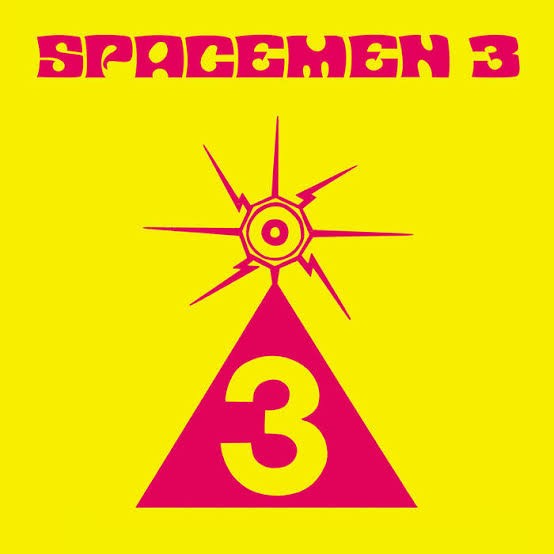
Spacemen 3: After the Trip
How Spacemen 3's divorce became two different ways of continuing the same search.
Picture a marriage so bitter the couple no longer speaks, but is bound by contract to keep sharing the same flat. Unable to look each other in the eye, they run a strip of masking tape across the living room and split the fridge in two: the top shelves for one, the drawers for the other. They don't cook together, they don't clean together, they ignore each other in the hallway, but on the front door the mailbox still carries both family names. That passive-aggressive cohabitation, where silence is louder than any slammed door, is the perfect metaphor for what happened in Rugby, England, on the doorstep of the last decade of the twentieth century.
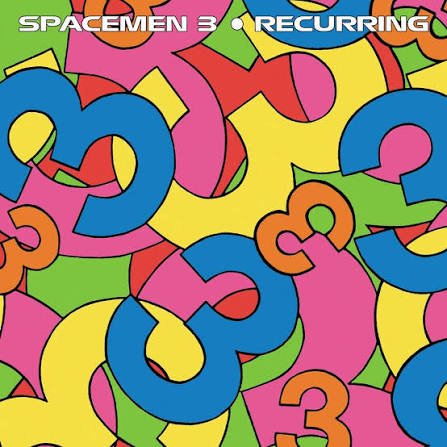
That shared flat had a name and a catalogue number: Recurring (1991). Spacemen 3, the band that had promised to take drugs to make music to take drugs to, ended its trip with its two leaders, Jason Pierce and Peter Kember, recording in separate studios, in separate cities, without exchanging a single word. The result wasn't a group album but a record split down the middle: side A entirely given over to Sonic Boom's synthetic hallucinations; side B to J. Spaceman's gospel mysticism and hypnosis. A monument to mutual contempt packaged under a single name.
What's genuinely interesting, though, isn't that Spacemen 3 ended this way. Bands split up every day, and rock is full of teenage friendships that end up settled between lawyers. What's strange is what happened afterward. Because that split record didn't simply produce two solo careers. It produced two different ways of continuing the same search. Kember began progressively stripping psychedelia of guitars, songs, and even rock itself, until all that was left was sound as raw material: drones, oscillators, repetitions, frequencies, accidents. Pierce seemingly took the opposite road: gospel, soul, melodies, crescendos, choirs, horns, strings; songs that kept getting bigger, as if everything could fit inside them. One moved toward the laboratory; the other, toward the church. And yet both seemed to keep chasing exactly what they'd discovered together in Rugby: how much music can do to us once we stop demanding that it progress, explain itself, or even behave the way we expect.
Margaret Thatcher didn't reach me from far away: I grew up in 1980s Spain, where her name came up constantly on the news and over lunch-table conversations, almost always wielded by the right as the mirror Felipe González's socialist government should have looked into — and didn't. Her neoliberal policies were often summed up in a phrase that sounded almost medical to me at the time — curing the patient by starving him — and which, years later, I understood better than I would have liked. I'll admit that cure brought England the economic modernization and financial jolt it needed; what I never fully came to accept was the toll it collected along the way. My fascination as a child, though, wasn't ideological: it was the hair. That lacquered helmet, sculpted with an almost architectural symmetry, unmoved by any criticism — the British working class's or half a generation of bands' — unmoved like her own politics. It doesn't take much of a stretch to picture that same woman, hairdo perfectly intact, standing behind the industrial boredom in which two Rugby kids met in 1982. Spacemen 3 were never a political band — no statement, no banner, no protest song — and it would be a mistake to turn them now into something they never wanted to be. But the almost pharmaceutical escapism with which they began treating music didn't grow in a vacuum. It grew in a provincial England that Thatcherism was stripping, year by year, of reasons not to be bored.
Rugby, 1982
The story of Spacemen 3 doesn't begin at Central Saint Martins or some art school overlooking the Thames, but in the industrial boredom of a provincial town in 1982. Rugby. Two kids. Few chords. Few resources. And a limitation that ends up turning into a discovery. Peter Kember and Jason Pierce met that autumn at the local art school and started swapping records and playing together. They listened to The Stooges, MC5, The Velvet Underground, Suicide, Bo Diddley, The Red Crayola — but there was an important difference between those records and themselves: Kember and Pierce could barely play. There was no theory yet behind their minimalism. If the songs had few chords, it was, among other things, because playing lots of changes was beyond them. Years later, Kember would sum up those beginnings in a rather less solemn way: they were trying to make something out of nothing.
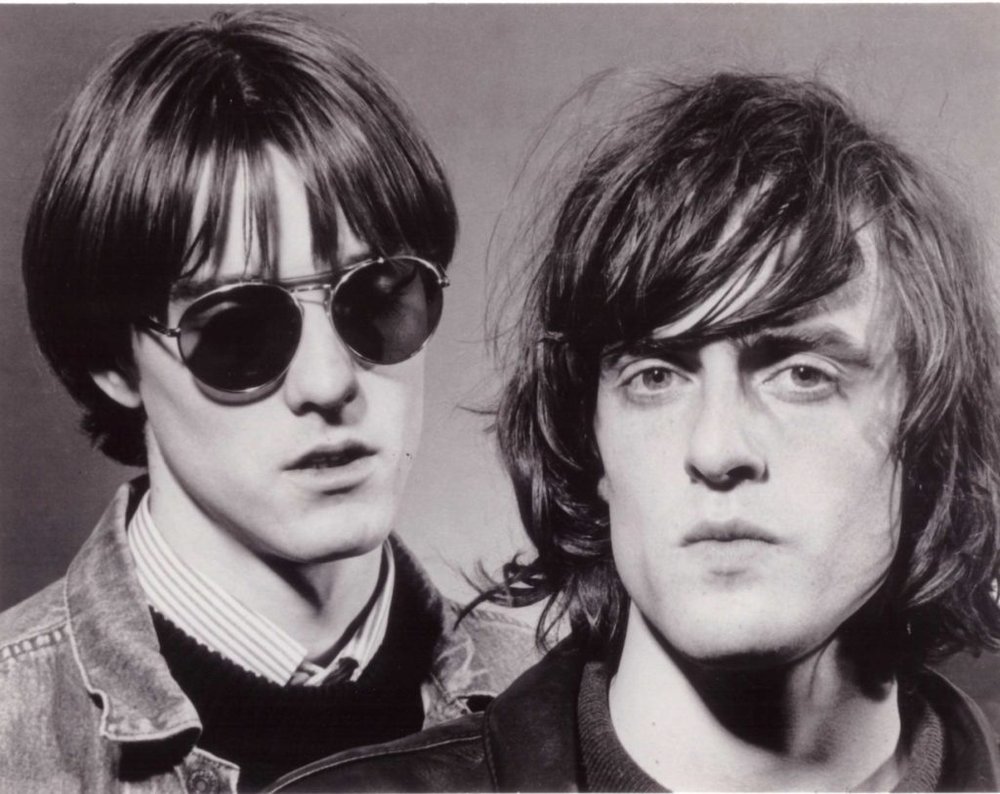
The interesting part is that nothing started producing results. Instead of hiding their limitations, they started discovering what happened when they stayed inside them: a chord could last longer than reasonable; a rhythm could repeat without needing to go anywhere; a song could rest on very few elements and still not sit still. The lesson was scattered across records that, on the surface, belonged to different worlds: Bo Diddley's rhythmic stubbornness, The Stooges' elemental electricity, The Velvet Underground's repetitions, Suicide's almost motionless machinery. Spacemen 3 didn't have a method yet, but they were starting to sense one. First they played little because they couldn't do much more. Then they discovered that, even once they could, there might be no reason to. Their faith, if there was one, wasn't religious but physical: repeat something until, at some point, it starts turning into something else.
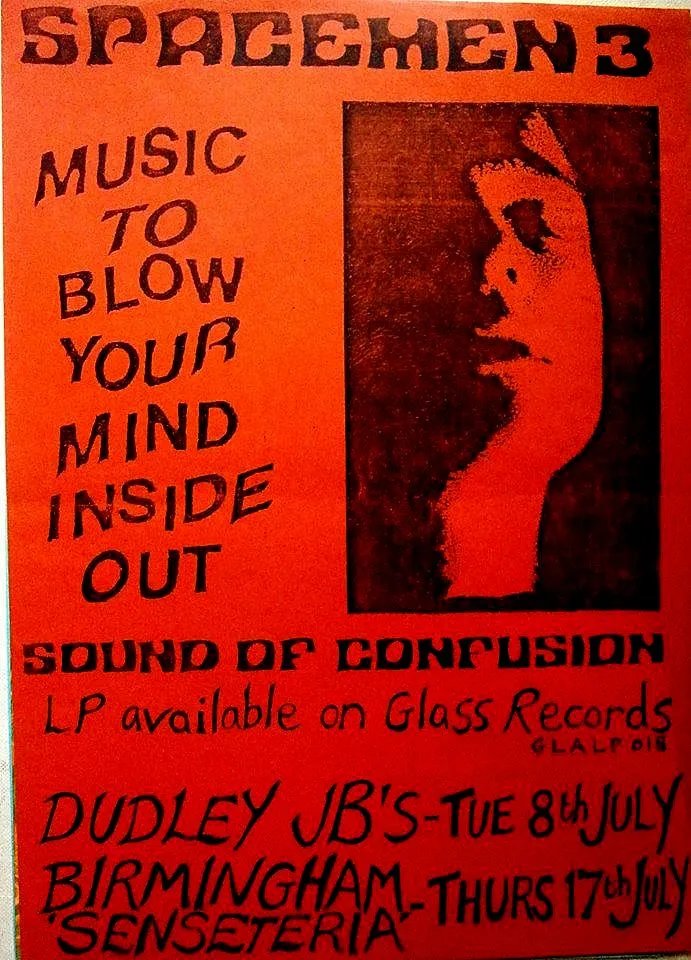
That impulse found its first public test on Sound of Confusion (1986). Spacemen 3's debut doesn't call for a historical reading of its influences so much as a close listen to its mechanics. In their reworking of The Stooges' "Little Doll," you can see what they did with borrowed raw material: they didn't cover it, they stripped it of its punk urgency and stretched it into a loop that repeats without moving forward (the record also carries the 13th Floor Elevators' "Rollercoaster," confirming the gesture wasn't a one-off). By contrast, when they started from scratch on "Losing Touch With My Mind," a single bassline held steady while the guitars repeated the same chord longer than necessary. On Sound of Confusion it's still worth asking how much of that economy came from what they knew how to do, and how much from what they were only beginning to discover.
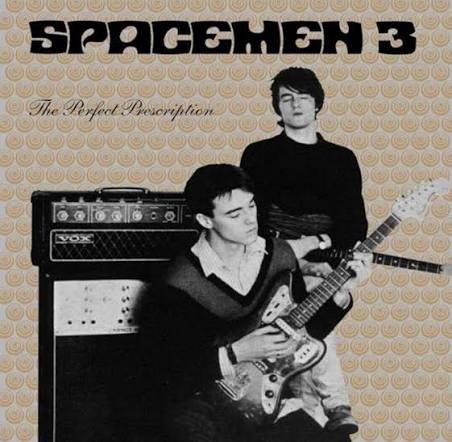
The real test came at VHF Studios with the recording of The Perfect Prescription (1987). This is where the story takes a genuinely strange turn. You'd expect two provincial kids, finding themselves for the first time in a professional studio with plenty of time on their hands, to go all out. And in part they did: the sessions filled up with layer upon layer of overdubbed guitars. But the paradox of the Spacemen 3 method revealed itself in the mixing room. Years later, the surfacing of alternate mixes would show the band put as much effort into adding electricity as into making it disappear. Sonic Boom himself would later explain they decided to strip out most of those guitar layers for a reason that was almost mundane: they sensed it would be impossible to reproduce live. What happens when people who learned to do a lot with almost nothing finally get the chance to do too much? The answer, again, was practical before it was aesthetic: they overrecorded, then kept only what a live show could carry.
That emptying-out sustains the tension of "Walkin' With Jesus," and also of "Ecstasy Symphony/Transparent Radiation (Flashback)," which reworks a piece by The Red Crayola — the same group Kember and Pierce had listened to on their teenage records back in Rugby — now stretched until the original chord is barely recognizable. But as that emptying-out was being perfected, the band's shared language began to crack in favor of separate territories. Rock's official narrative always prefers loud divorces, slammed doors, punches thrown in the dressing room, but the distance between Pierce and Kember widened in a silence that was strictly musical.
By the time Playing With Fire (1989) came out, that musical silence already had a concrete example. In the credits for "Lord Can You Hear Me," the album's most confessional and spacious track, Kember's involvement is conspicuously absent; Pierce recorded the song entirely without Kember's guitar. Seen that way, the split vinyl of Recurring in 1991 didn't inaugurate any traumatic rupture. In a sense, that divided record was simply the divorce paperwork for a couple who'd already spent two years learning to live in separate rooms.
The result of that internal move was, of course, Recurring (1991). Rock mythology loves its pyromaniac endings, the guitarists who come to blows in the middle of a TV set, the singers who dissolve their band with a handwritten note left in the dressing room. Spacemen 3, true to their policy of conserving energy, preferred the bureaucracy of a silent eviction. The farewell record wasn't testimony to a dramatic rupture, but the notarized record of an extinguished cohabitation. Returning to its grooves knowing how their method operated, the split between sides stops being a contractual eccentricity and becomes an auditory map. Just comparing the openings of both halves is enough to fall into the trap: side A kicks off with "Big City," where Kember dissolves the band's inheritance into a trance of drum machines and electronic loops; side B opens with "Feel So Sad," where Pierce cushions the blow of the divorce by taking shelter in ambient guitars and an almost liturgical breath.
Heard in hindsight, those two paths invite an extraordinarily convenient interpretation. After the final closing of the Rugby flat, Kember moved toward pure sonic abstraction while Pierce widened out into a spiritual, communal dimension. You'd say one kept the laboratory and the other kept the church. One operating under the alias Sonic Boom among oscillators, drones, and radio frequencies; the other fronting Spiritualized, building cathedrals of sound with room for gospel choirs, horn sections, string orchestras. One seemingly chasing the coldness of the machine; the other, the elevation of the spirit.
It was a perfect explanation, elegant and extremely convenient. The only problem is that it was a lie.
Side A: Kember
That lie, though, was built on the appearance of unassailable scientific rigor. Peter Kember shed the inertia of the traditional rock band and holed up in the isolation of projects like Spectrum and Experimental Audio Research (E.A.R.). Seen from outside, the move was read as a formal abdication of the human element in music: Kember shoved the electric guitars into a corner and started surrounding himself with an arsenal of analog synthesizers and oscillators that, he'd admit years later, he barely knew how to work — he'd already fiddled with synths in Spacemen, but he didn't really understand how they functioned. Albums like Soul Kiss (Glide Divine) (1992) were billed as the fulfillment of that asceticism, but the record contradicted that from within: under the tremolo and flanging there were still choruses, a voice that arrived like a breeze rather than an order, songs that stubbornly insisted on remaining songs.
In the years that followed, Kember's trajectory only fed the suspicion that he'd turned into a hermit of the machine. While his former partner started recruiting whole horn sections and choirs in London studios, he operated at the margins of the industry, learning by trial and error to tame an arsenal that still resisted him. On the surface, it looked as though Kember had succeeded in dehumanizing the trance, folding inward into a centripetal abstraction where the listener no longer found songs to hold on to, only pure frequencies demanding a purely physical attention.
That long sentimental education with cables crystallized in Forever Alien (1997), a record whose cover — a close-up of an EMS VCS3 synthesizer — functioned as a declaration of absence: Kember had erased himself so the material could speak. The oscillator offered him something like a frozen desert: a territory he felt had no folklore, no one to answer to, just an electrical current waiting to be tamed out of the void. Anyone who read that turn as a surrender to technological coldness understood nothing. Kember wasn't fleeing emotion; he was fleeing inheritance. When he confessed those machines offered him "endless" possibilities, he wasn't talking like an engineer, but like a mystic discovering a language with no adjectives. His sound no longer sprang from skill, but from wonder: the wonder of a man who, after years of chasing infinity on strings, found freedom playing electricity by ear.
Twenty-five years after Forever Alien, Kember found himself once again working with much more modest materials. For Reset (2022), his record with Panda Bear, the two of them began clipping the opening bars of old fifties and sixties singles: Eddie Cochran, The Everly Brothers, The Drifters, Randy & the Rainbows, The Troggs. They weren't after whole songs, but fragments: a few seconds before a melody had finished revealing where it was headed. They turned them into loops and started working from there.
The procedure had something of a domestic game about it. A small piece of someone else's music went into the machine, came back out, went in again, and after enough turns, stopped belonging entirely to the place it had been lifted from. Over those minimal circles, voices, rhythms, and new melodies appeared, but the engine stayed underneath, stubbornly repeating information that would fit into a few seconds.
Side B: Pierce
Jason Pierce took the opposite direction, or at least that's how it seemed. Barely a year after Recurring, Lazer Guided Melodies (1992) still held onto some of Spacemen 3's weightlessness, but it was starting to widen the space around it. The guitars kept repeating minimal figures and the songs could go on for minutes over a handful of chords, only now organs, percussion, and voices drifted in and out of the mix, as if Pierce were discovering how much air he could fit between the same elements that had once been used to build a wall of sound. "Shine a Light" offers perhaps the clearest picture: it opens almost bare, held up by a guitar and a voice that barely seem to want to move, and ends by slowly opening out until it occupies a space far larger than its starting materials. Pierce hadn't abandoned the economy learned in Rugby. He'd started asking how far he could grow it.

On Pure Phase (1995), the space started opening up inside the sound itself. Listened to closely, something on the record seems to breathe: the same phrases drift slightly apart from themselves, draw close, drift apart again, as if the air inside the speakers had a tide of its own. Pierce would later describe the sensation as diving into "a world of opiate drone," and the effect, far from subtle, was almost physical: a real movement, he'd say, "something really beautiful." All you had to do was let it carry you.
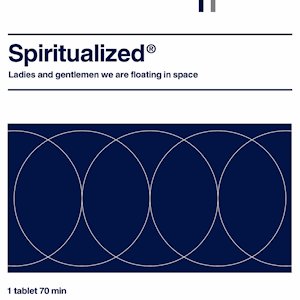
Two years later, Pierce turned that experience into an object you could dispense. Ladies and Gentlemen We Are Floating in Space (1997) came presented like a medication: a box with a dosage-instructions insert and the disc sealed in an aluminum blister pack. In the limited edition of two hundred copies, the twelve tracks were spread across twelve CDs arranged in two strips of six, like pills in any pharmacy blister pack. Before a single note played, the music was already being offered as something to be administered.
But Pierce could still raise the scale further. For Let It Come Down (2001) he brought together 115 musicians, including an orchestra and the London Community Gospel Choir. And at the end of a record built on such a scale, he chose to return to a song written twelve years earlier. The final track was "Lord Can You Hear Me." That piece, which had appeared on Playing With Fire right as Pierce and Kember were starting to work in separate musical rooms, now came back reborn as a Spiritualized recording, with Mimi Parker of Low singing alongside him. The material was still recognizable. Everything Pierce had learned to build around it had changed.
Track number eight
But let's go back for a moment to that tide. The movement that seemed to breathe inside Pure Phase hadn't shown up by accident. Pierce had prepared two separate analog mixes of the record and played them simultaneously. Since tape machines never ran at exactly the same speed, the two versions gradually started drifting apart: the sounds shifted, crossed over each other, and generated that sense of movement running through the recording. Roughly every eight bars, Pierce would step in, cut the tape, and realign the mixes before letting them start drifting apart again.
There was something paradoxical about the process. To make the music seem to float freely, Pierce had built a system that demanded almost obsessive attention: letting the machines drift, listening to what happened, and pulling them back to the starting point so they could drift apart again. What he would later describe as a "world of opiate drone" wasn't the opposite of engineering. It was its result.
Kember hadn't reached his supposed laboratory alone either. During the Forever Alien sessions, while working on a piece titled "Delia Derbyshire," he managed to track down the former BBC Radiophonic Workshop member by phone and began a mentorship with her that would end up deeply shaping how he understood sound. Derbyshire had spent decades working with exactly what Kember was starting to explore: electronic tones, manipulated tape, altered speeds, sounds built before any popular vocabulary even existed to recognize them. Kember would later say she'd taught him practically everything he knew about the structure of sound.
There was a certain irony in that meeting. Kember had found in synthesizers a way to escape the inheritance he felt stuck to the guitar, but the machines had their own genealogies too, their own masters, their own knowledge passed down from one generation to the next. The supposed desert had inhabitants. And one of them had just taught him how to listen.
The border was starting to become hard to hold.
The scientist was searching for spirit through the machine, and the priest was doing engineering at the mixing desk.
They hadn't ended up in the same place, and they weren't making the same music: Kember kept moving deeper into sound; Pierce kept building outward. What they shared was something less visible than a style.
The two trajectories could look opposite. Kember had spent years going deeper into sound, discovering how much he could pull out of a frequency, a machine, a few seconds of music running on a loop. Pierce had made the opposite journey: around a handful of notes he'd kept raising bigger and bigger spaces, until he needed 115 musicians to test how far a song could grow without stopping being the same song. One seemed to move forward by subtracting, the other by adding. But the difference was starting to matter less than a coincidence: neither seemed especially interested in the amount of material in front of him. What mattered was what he could do with it.
Maybe that's why it's worth going back to Rugby one last time. In 1982, when Kember and Pierce started playing together, there were no electronic drones yet, no gospel choirs, no orchestras, no EMS synthesizers. There was no theory either. There were two musicians with limited resources trying to find out what might happen if a very simple idea was held on to for long enough. At first, repetition solved a problem: it let them make music with almost nothing. Later they discovered the problem could become a procedure.
From there the instruments changed, the studios changed, the scale changed, but the operation keeps resurfacing again and again. Take something simple. Isolate what produces an effect. Repeat it. Alter it. Let a machine, an accident, or someone else's voice introduce something unplanned. Listen. Step back in. Stop, not when the song satisfies the rules of a genre, but when the material starts doing something it wasn't doing before.
That was what had survived.
Spacemen 3 didn't survive as a sound. It survived as a method.
So let's return, one last time, to the record. The CD edition of Recurring has fifteen tracks. The first seven are credited to Kember. The last seven to Pierce. And right in the middle, at track number eight, there's a song that belongs to neither of them: a cover of Mudhoney's "When Tomorrow Hits." Between one half and the other, the only thing that carries neither Kember's name nor Pierce's is a borrowed song about tomorrow's arrival.
Tomorrow, when it came, didn't arrive the same way for both of them. It found Kember going ever deeper into sound, until he ended up working with a few seconds running on a loop. It found Pierce growing songs until he needed 115 musicians to hold them up.
Maybe there's no need to decide what it means that this particular song occupies that particular spot. It probably means nothing. But after hearing everything that came afterward, it's hard not to return to track number eight: two perfectly separate halves, and, on the border, a song neither of them wrote.
It was called "When Tomorrow Hits."