For a decade, Kyle Dixon and Michael Stein scored the imagined past of Stranger Things. Ten years on, those synthesizers have started remembering something the show never meant to: our own lives.
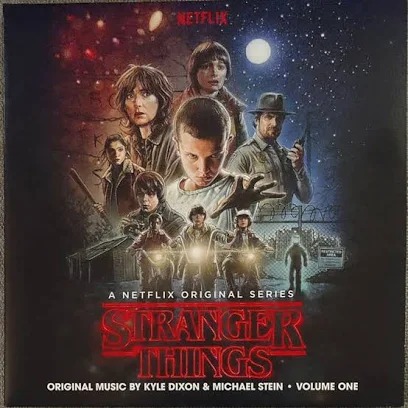
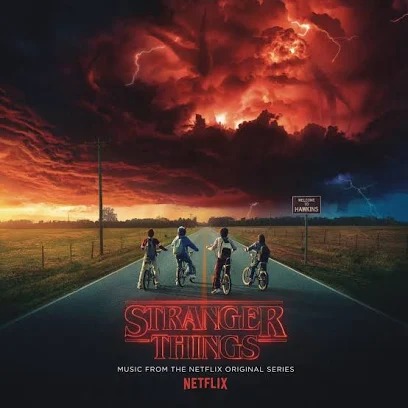
You arrive at certain concerts with too much already in your head. Records, expectations, images. In my case, also a fairly serious collection of Stranger Things soundtracks, including vinyl and cassettes in various editions and colors. I wasn't exactly the audience Dixon and Stein needed to convince that their music was worth it.
Maybe that's why I expected so much.
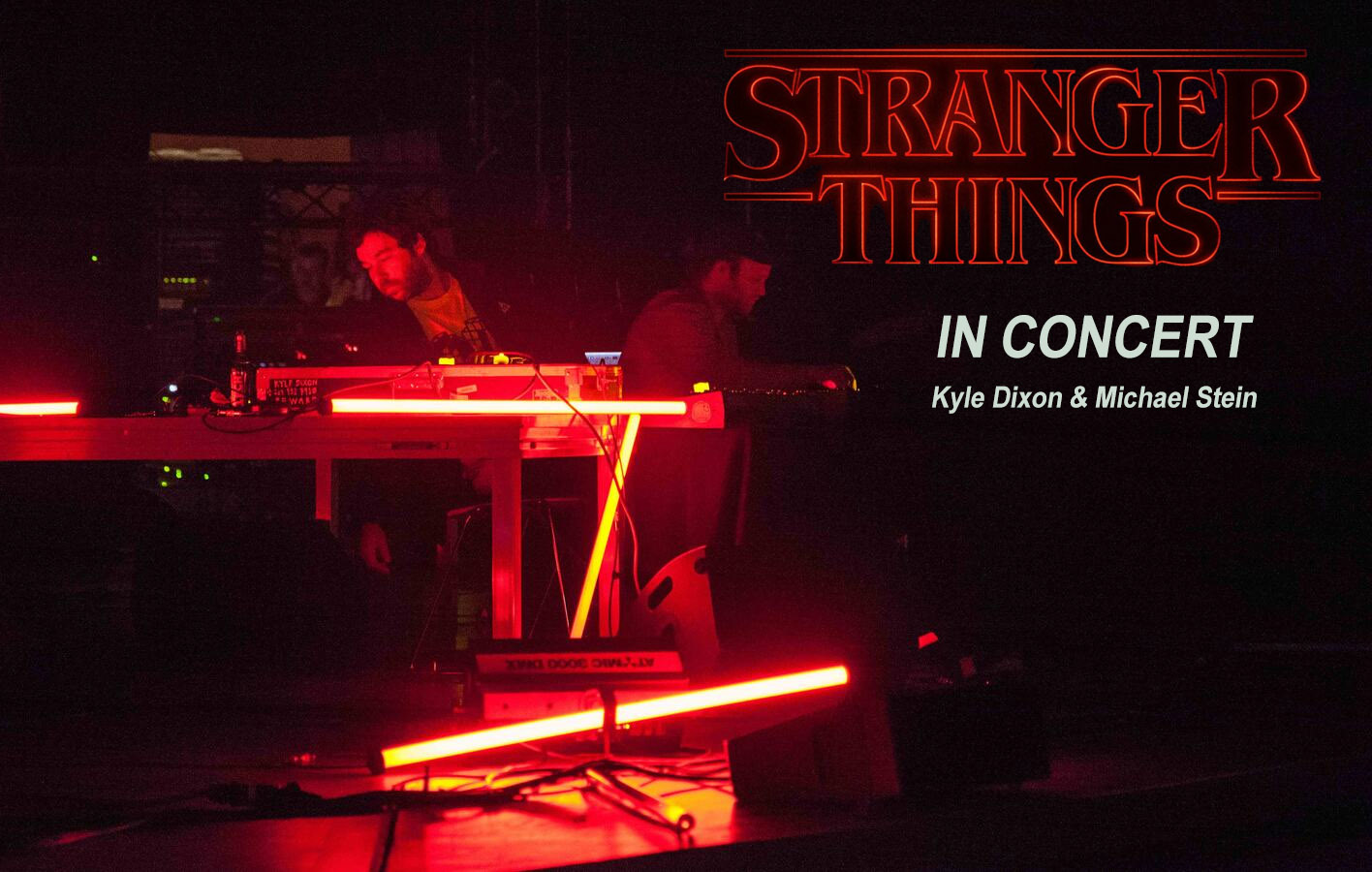
Before Kyle Dixon and Michael Stein actually appear on stage, they're already there. The Gran Teatro CaixaBank is almost dark. You can just make out two figures among synthesizers, cables and machines, while the music starts filling the room before we can properly identify who's making it. There's something fitting about that: for ten years we've been listening to Dixon and Stein without seeing them.
The theater is nearly full, just a handful of empty seats. We come in looking for ours while the synthesizers build a dense, heavy soundscape. No image from Stranger Things has appeared yet, but my head is already manufacturing them.
Once we're seated, with a faint light over the stage, I get the impression that most of the audience is waiting for the same thing. The main theme's arpeggio has become one of those sounds that no longer need an introduction. A few notes are enough. No bicycles, no Christmas lights, no Demogorgon required: Hawkins comes included.
When it finally plays, reinterpreted while just a couple of lights sweep across the theater, there's that small moment of collective recognition only certain pieces of music can pull off. Silence in the seats, full attention. For a few seconds it feels like we're at the start of a new chapter.
Then come a few white flashes and we're back in the dark. The sounds grow denser and heavier, and something happens that will keep happening for most of the concert: without meaning to, I start laying images over the music.
Someone Else's Eighties
There's a small anomaly at the heart of Stranger Things. Millions of us recognized those eighties instantly, even though for many they only ever existed through movies, songs, photographs, or other people's stories.
Those of us who did grow up in that decade don't quite find our childhood in Hawkins either. My eighties, at least, had considerably less Spielberg than collective memory now seems to demand. I didn't ride a BMX through Indiana suburbs looking for missing friends, or own a walkie-talkie for contacting a parallel dimension. Real childhood is usually worse lit, and has a lot more dead time in it.
And yet Hawkins feels familiar.
We recognize the bikes, the kids' bedrooms, the arcades, the malls, the typefaces, that strange mix of adventure and threat. We even recognize its synthesizers.
Because when we think of 1983, we're no longer thinking only of what actually happened in 1983. There's also Spielberg, Carpenter, Stephen King, video stores, horror movies, family photographs. For decades, all those images have been settling over our memories until they merged with them. Stranger Things knew how to build its world out of exactly that material: not so much the eighties as everything we've kept remembering, imagining and projecting onto them.
The Duffer brothers themselves were born in 1984. Their 1983 couldn't come from direct childhood memory either. Like a good part of ours, it was made of movies, television, music, and objects other people had kept.
There was a time when synthesizers were used to imagine the future. For much of the second half of the twentieth century, electronic music was the sound of what hadn't happened yet: laboratories, future cities, space travel. A synthesizer could produce sounds we didn't have a memory for yet.
A synthesizer could produce sounds we didn't have a memory for yet.
At some point that relationship flipped. The sounds that had once stood for tomorrow aged and turned into recognizable signs of an era. They still sounded futuristic, but that future now belonged to the past.
Stranger Things showed up right in that temporal crack. It used the sound with which one generation had imagined the future to reconstruct how another generation wanted to remember 1983.
The Trojan Horse
Reducing all that to nostalgia would be unfair to Dixon and Stein. They didn't arrive at Netflix wondering which knob to turn to sound like John Carpenter: they came from S U R V I V E and an electronic scene that had spent years working with analog synths and drones, far from anything you'd associate with a production for millions of viewers. The Duffers hired them after using one of their tracks in the material they used to develop the show.
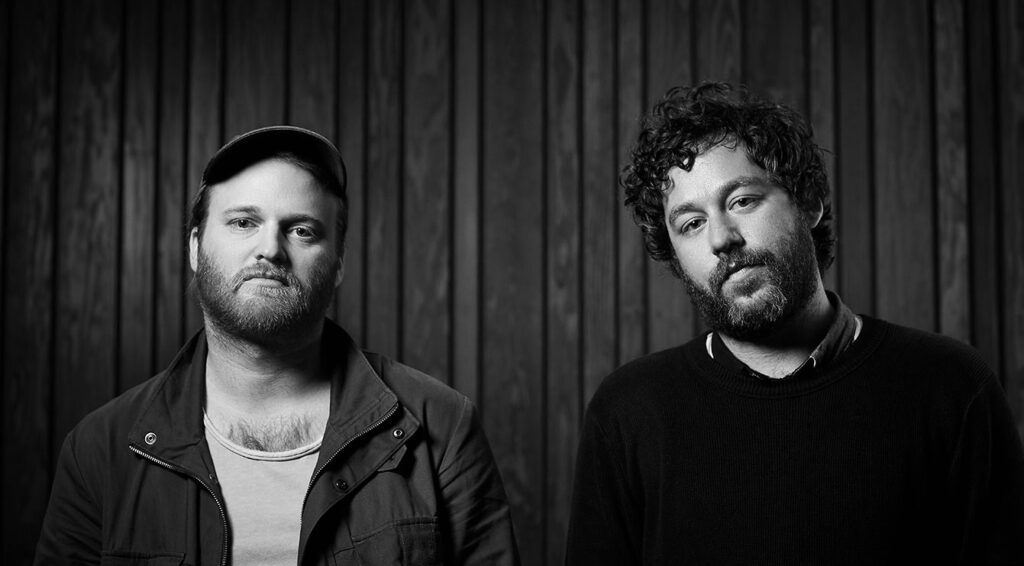
Without meaning to, Netflix carried that vocabulary — arpeggiators, drones, analog textures — into millions of homes that would never have bought a S U R V I V E record.
In the theater, you can hear what remains when the wrapping is taken away.
"Kids" gives one of the clearest moments. After several dense passages, the melody opens something like a window. Flashes of light cross the room and the built-up tension eases. And then the images come back: the characters, the bikes, an American childhood that was never mine and that I nonetheless know perfectly well.
Nostalgia comes with them, though by 2026 it doesn't work quite the way it did in 2016. The first season of Stranger Things came out ten years ago, long enough for a work built around the memory of another era to start generating memories of its own. Someone who was fifteen when they discovered Hawkins is twenty-five now. They may not remember 1983, but they can remember perfectly well where they lived in 2016, who they watched the show with, what they were listening to at the time. They can remember a room that no longer exists, a relationship that's over, or kids who were still small.
That's where something strange starts to happen. Stranger Things invited us to feel nostalgic for an eighties reconstructed through pop culture, and ten years later, we can feel just as nostalgic for the moment we first discovered that reconstruction.
1983 and 2016 start blurring together inside the same music. Listening to it today adds a third date, 2026, and it isn't always easy to tell which of the three what we're feeling actually belongs to.
A Past That No Longer Knows How to Disappear
In the eighties, things could disappear: a record would go out of print, a film could take years to screen again. Forgetting was part of our relationship with culture.
Now we live inside an archive — Spotify, hard drives, the cloud — that doesn't let anything get lost, and that hasn't made us any less nostalgic. We can pull up almost any cultural object from our lives and find that none of them contain what we were looking for. The song is still there, Stranger Things is still there; what's changed is the person who first heard it.
It's one of the small cruelties of the digital archive: it promises that nothing will be lost and ends up proving, with remarkable precision, everything we've lost. We can replay the first episode as many times as we want; the one thing it can't give back is the room we watched it from in 2016.
In the theater, meanwhile, everything turns red. "The Upside Down" plays with a heavy cadence, as if something enormous were slowly approaching. The tension builds until the room drops back into darkness. For much of the show, that will be the visual language: smoke, dimness, flashes, a few lights crossing the space without any especially obvious sync.
At first, that austerity seemed like a virtue. The absence of images forced you to find out what the music could do on its own. As the minutes go by, I start wondering whether it might also be a problem.
What's Missing When You Take the Images Away
There's a strange moment near the end. Some people in the audience start leaving their seats. It isn't entirely clear when the show has actually ended, and part of the audience leaving early adds to that feeling.
Up to that point I'd been mentally laying images over the music myself. They'd shown up with the main theme, with "Kids," with "The Upside Down." In a sense, the experiment worked: Dixon and Stein could take away the screen because each of us was carrying one inside our head.
But I start missing it.
Not a string of scenes from the show — that would have been little more than a screening with a live soundtrack — but something able to talk back to music that, for years, we learned to hear alongside images.
The darkness that created tension at first starts repeating itself. Some of the lights feel poorly matched to what we're hearing, and the ending arrives in a way that strikes me as a little forced. I leave with a strange feeling, especially since I'd walked in ready to enjoy it.
I'm not exactly a casual visitor to this music. I collect Dixon and Stein's soundtracks on vinyl and cassette, in several editions. I still think they're extraordinarily good at building those soundscapes, and that a large part of Stranger Things' identity would be unthinkable without them. Maybe that's why the disappointment is harder to shake off.
The question is no longer so much whether the music can survive without the images, but what we lose when we take them away.
For ten years this music and those images have learned to live together. Pulling them apart reveals the strength of Dixon and Stein as musicians, but it also exposes just how much our relationship with their compositions was built watching bikes cross Hawkins, or a red dimension open up on the other side of the screen.
Some people were leaving early. Maybe they'd expected a different kind of show, or maybe they just had somewhere to be; it would be unfair to turn a handful of people standing up from their seats into a referendum on the state of contemporary electronic music. All I know is that while they left, Dixon and Stein kept working their synthesizers in the dark.
The Other Side
Walking out, I'm still thinking about those four notes. Something about them has changed since 2016: back then they pointed toward 1983; now they can also take us back to 2016. After tonight, for those of us who were there, maybe they'll carry a bit of 2026 too.
Soundtracks are born tied to specific images and later try to break free of them. Some manage it; others leave something behind when they try.
The Gran Teatro CaixaBank was still dark. Dixon and Stein were still surrounded by machines, smoke and small lights. Hawkins had never physically appeared on stage, and yet I'd spent much of the concert watching a place I'd never been.
The strange part was discovering, once it was over, that I'd missed seeing it too.