A Short History of the Bodiless Voice, from 1939 to Tomorrow
For almost a century we have tried to separate the voice from the body that produces it. What began as a technical feat has ended up becoming a question about who is speaking when we hear a voice.
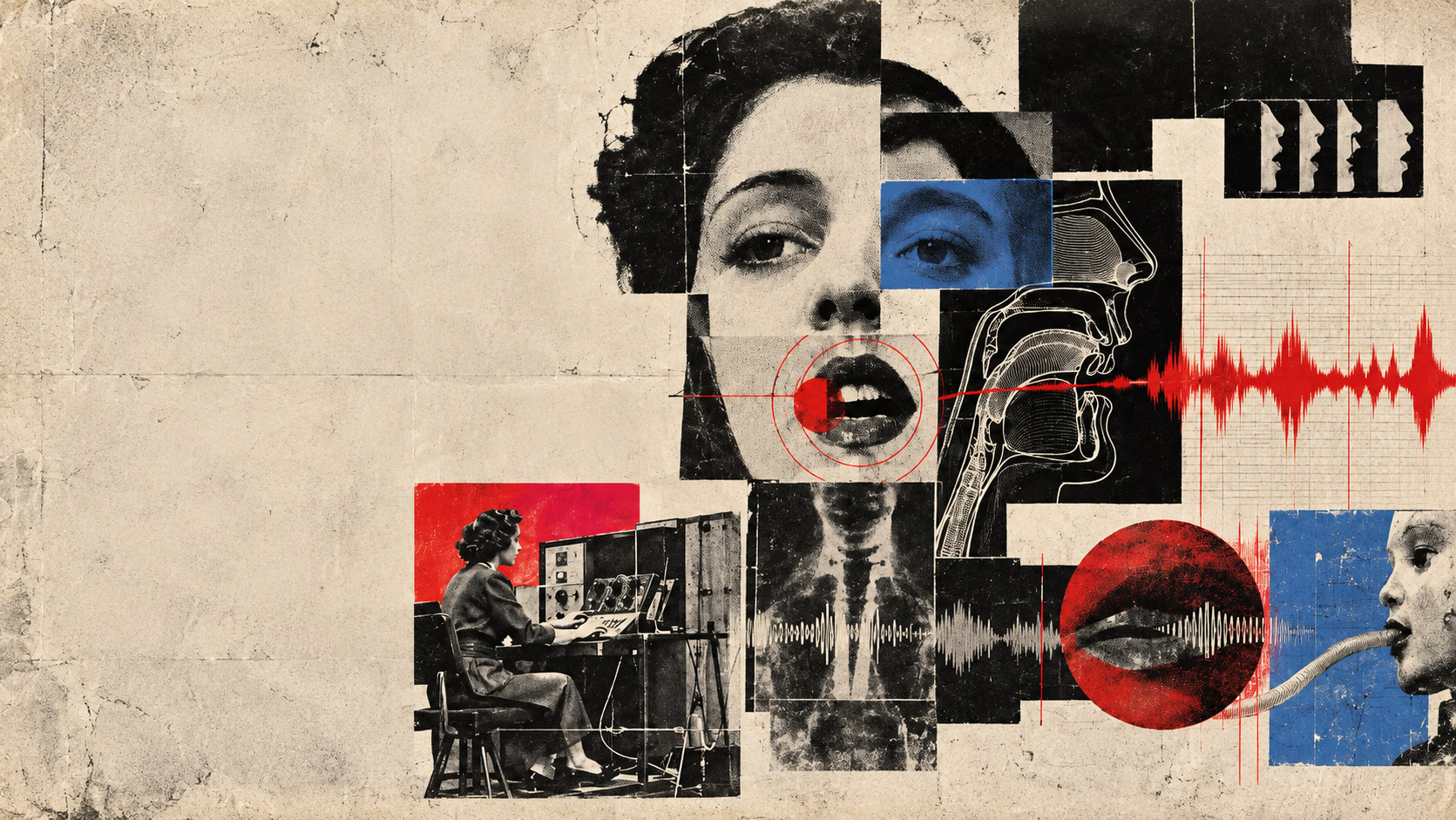
1. 1939: Two Futures for the Voice
The New York World's Fair had been built at Flushing Meadows, a former ash dump in Queens, and it announced itself with a modesty very much of the twentieth century: The World of Tomorrow. Cars, household appliances, highways, telecommunications. The future arrived spread across pavilions, and it seemed convinced that almost any human problem would end up being solved with enough electricity.
In the AT&T pavilion, a woman made a machine talk without opening her mouth.
Helen Harper sat in front of a console with a keyboard, a bar she worked with her wrist and a pedal. There was no hidden recording and nobody waiting at the other end of a line. When she began to move her hands and her foot, words came out of a loudspeaker. The machine was called the Voder.
Bell Labs had developed it out of Homer Dudley's research into speech synthesis. Harper was its chief operator and helped train some twenty women able to handle it. Learning took about a year. To show how hard it was, Harper used a single word: concentration. Pronouncing it meant chaining together thirteen sounds and coordinating several movements of wrist and pedal.
It wasn't exactly speaking and it wasn't exactly playing an instrument either. It was performing a vocal apparatus that didn't exist. The Voder didn't reproduce a voice: it fabricated one. There was no throat hidden somewhere, no person whose voice was being transformed. It produced nobody's voice.
But 1939 also found the opposite road.
Alvino Rey was experimenting with a steel guitar that seemed to talk. A throat microphone placed on the neck of his wife, Luise King, picked up the articulations she made hidden behind a curtain. The audience saw a guitar; the mouth stayed out of frame.
That same year, Gilbert Wright made another, less solemn discovery. He hadn't shaved and was scratching his beard over his Adam's apple when he noticed that the noise seemed to come out of his mouth. He tried articulating words silently, and they could be understood. That was the origin of the Sonovox, a set of transducers applied to the neck that let you use the mouth and throat to shape a sound that came from outside. Disney would end up using it to give a voice to the train Casey Jr. in Dumbo.
The future of the voice forked almost from the start. In New York, the machine tried to get free of the body. On the West Coast, it needed to get inside it.
2. Taking a Throat Apart
To get to the Voder you have to go back a decade.
Homer Dudley began working on the vocoder at Bell Labs in 1928 because transatlantic cables posed a problem less spectacular than making a machine talk: they had limited bandwidth, and carrying voice was expensive.
Dudley looked for a way not to carry the whole voice. The vocoder analyzed certain characteristics of speech and sent the signals needed to rebuild it at the other end. Instead of transmitting every vibration produced by a throat, it transmitted something like its assembly instructions.
The voice had become something that could be taken apart: it could disappear at one end of the line, travel reduced to information and reappear at the other. The Voder drew on the synthesizing side of that research. If a machine could rebuild speech from instructions, it could also produce it without any original voice existing.
The World's Fair turned a solution to a telecommunications problem into a spectacle. Four years later, the war found another use for it.
From 1943, the conversations of the Allied leaders crossed the Atlantic protected by SIGSALY, a system that used Dudley's vocoder as part of its workings. One of its terminals was in the basement of Selfridges, on Oxford Street, and among its enormous equipment were two turntables.
Upstairs, a department store. Downstairs, the war, encrypted with records.
Before it reached the recording studio, the electronic voice had already been used to save space, to entertain visitors at a fair and to hide conversations that no one else was meant to hear.
3. The Machine Inside the Mouth
The talkbox took the other branch of that fork.
How it works seems sophisticated until it's explained. The sound of a guitar or a synthesizer is sent through a plastic tube that ends inside the musician's mouth. There, tongue, teeth, palate and cheeks physically modify the signal. A microphone placed in front picks up the result. The future, for a while, needed quite a lot of saliva.
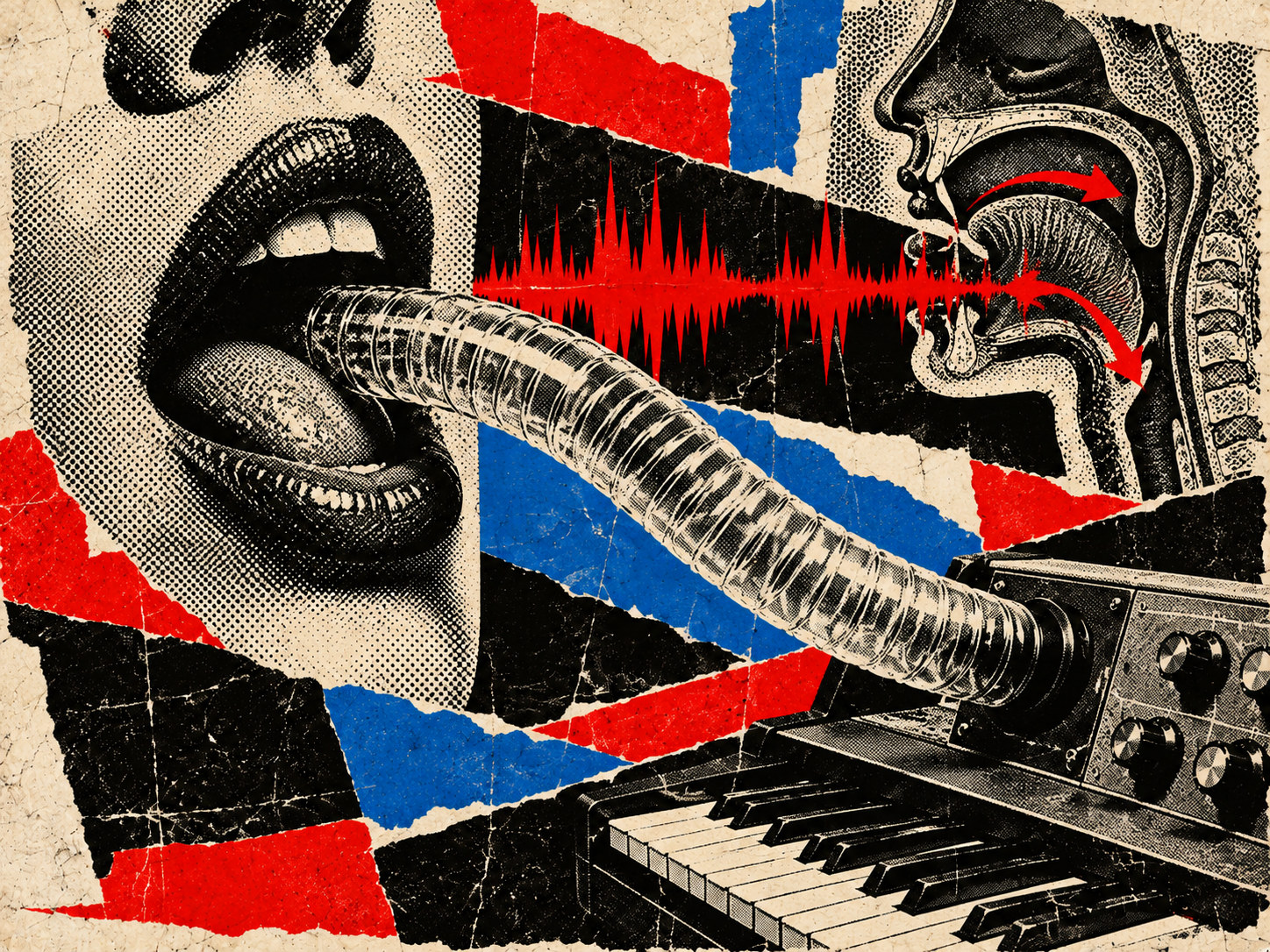
Roger Troutman turned that rudimentary sonic plumbing into one of the most recognizable voices in funk. In 1980, for More Bounce to the Ounce, he used a talkbox connected to a Minimoog. The synthesizer reached, quite literally, into his mouth and stopped being merely an electrical signal there.
Troutman didn't use the device to disappear, but the opposite. Syllables stretch, fold, dance around the beat. Technology doesn't cool the performance: it makes it strangely physical. It's hard to forget that somewhere in the circuit there are teeth, tongue, breath and a man trying to keep the tube from slipping out of his mouth.
The talkbox needs too much body to make it disappear. The machine uses it as a room.
4. Useful Phrases for the Future
A few years earlier, in Düsseldorf, Kraftwerk had taken the opposite road.
On Radio-Aktivität, from 1975, the processed voice no longer appeared simply as an effect. In "Die Stimme der Energie," energy itself seemed to have found a voice to introduce itself to the world.
Some of the most revealing sounds would come later, and by a far less monumental route. The voices on Computer World didn't come from some mysterious computer built in Düsseldorf. Kraftwerk also used a Texas Instruments Language Translator, a small device designed for travelers that offered translations and useful phrases in several languages.
Kraftwerk was making songs about computers, data, numbers and identity in the new computerized society using the sonic vocabulary of a phrasebook for businessmen.
The voice of the future came from the useful-phrases section.
For a good part of the public, the differences between vocoder, speech synthesis and other processors ended up mattering less than their shared effect: a voice could keep the words and, at the same time, lose some of the clues that let you imagine the body behind it.
With Troutman, the machine turned the mouth into a spectacle. With Kraftwerk, we were beginning to get used to not needing to see it.
5. The Mistake That Decided to Stay
Auto-Tune was born precisely so that nobody would notice the machine.
Andy Hildebrand had spent years at Exxon processing seismic signals. The mathematical techniques used to detect patterns in the echoes of the subsoil could also be applied to another kind of vibration: a sung note. The mathematics that had looked for oil ended up tuning voices.
Auto-Tune reached the market as a corrective tool. If a singer strayed slightly from a note, the program could put it back in place without leaving any apparent trace.
In 1998, Cher was recording Believe and wanted her voice to resemble the vocoder effect she had heard on a Roachford song. Looking for that sound, the producer Mark Taylor pushed Auto-Tune to a setting it hadn't, in principle, been designed for. The natural transition between one note and the next disappeared.
The voice stopped sliding. It jumped.
The error the program had been designed to hide became the sound that identified the song.
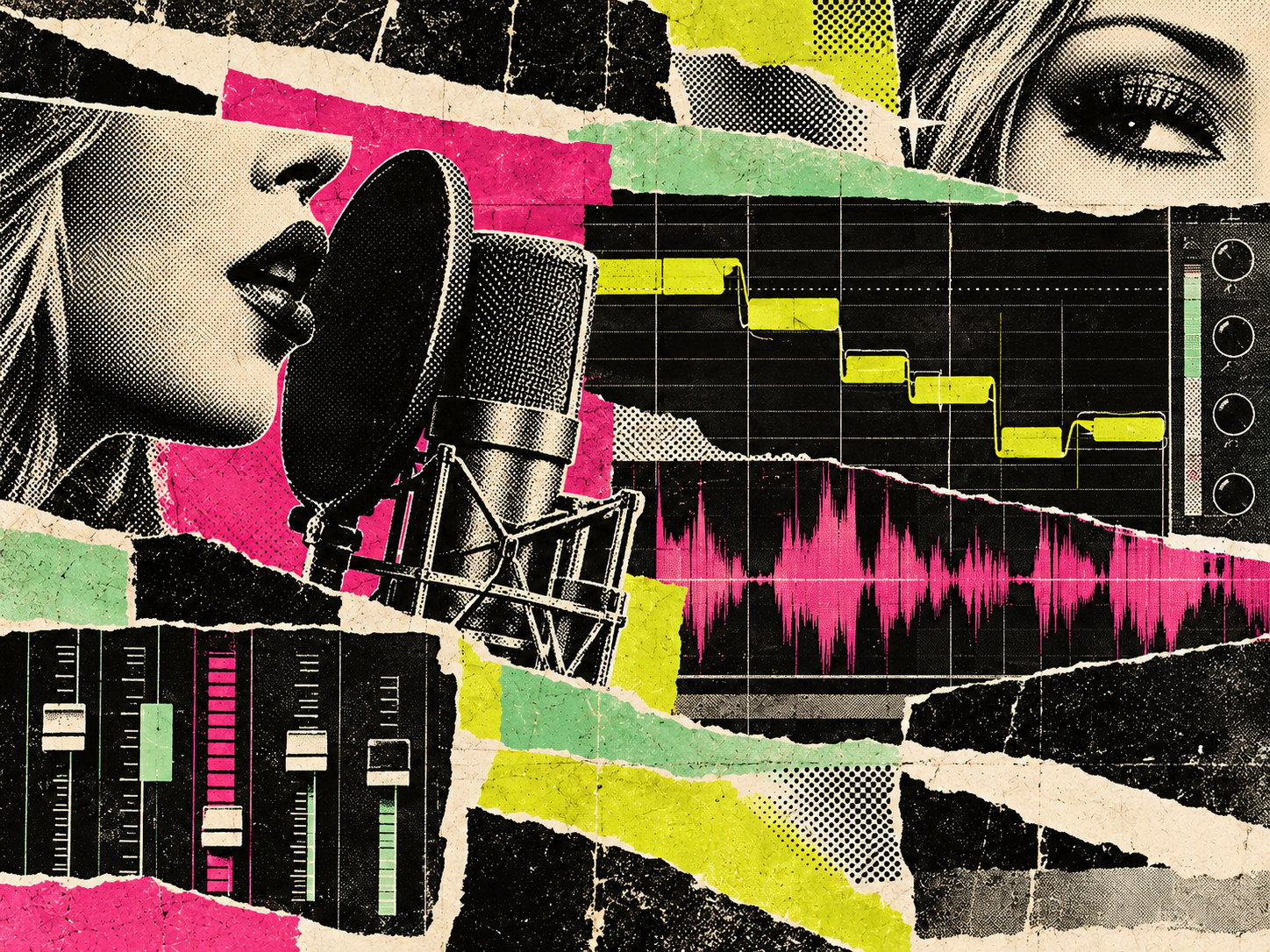
Months later, when Sound On Sound asked how they had done it, Taylor credited the effect to a DigiTech Talker, a vocoder-type device. It wasn't true. Cher had asked for something like a vocoder, they had given her Auto-Tune, and the result was presented to the world as a vocoder.
The new technology entered pop disguised as the old one. Then it stopped needing the disguise.
For half a century we had wanted machines to talk like people. Now we wanted to hear people sound as if a machine had touched them.
6. Someone Else's Voice
In the early sixties, an IBM computer at Bell Labs sang "Daisy Bell." Arthur C. Clarke heard that demonstration during a visit. Years later, when HAL 9000 is slowly disconnected in 2001: A Space Odyssey, the machine's intelligence retreats toward one of its earliest memories. It sings "Daisy Bell."
The first time I heard Stephen Hawking's voice was in Valladolid. I was home alone, talking on the landline, with the television on in the background. Suddenly a flat voice, without breath, came out of the screen, and I thought a computer was speaking. A few years later I no longer thought that: it was Hawking's voice. All that time I took for granted that the voice was part of him, like the chair or the gaze. It never occurred to me to ask whose it had been before.
Dennis Klatt had spent years researching at MIT how to get a machine to produce intelligible speech. Perfect Paul, the best known of the voices that came out of his work, was based on his own.
A company called Speech Plus refined that technology and built it into a synthesizer, the CallText 5010. One of those units ended up installed on the back of a wheelchair in Cambridge: Stephen Hawking's, who had lost his natural voice after a tracheotomy in 1985.
The technology kept advancing and more natural alternatives appeared. Hawking preferred to keep that voice. He didn't want a more convincing or more human one.
He wanted that one.
Dennis Klatt never got to know. In the mid-eighties, while his voice was starting to be recognized as someone else's, he was losing his own. He died in 1988.
In time, the original hardware became impossible to maintain and had to be emulated in software, on a small computer attached to the chair. The technology changed; the timbre remained. A voice that had begun in the throat of an American engineer ended up becoming part of the public identity of a British physicist.
In 2007, Hatsune Miku complicated things further. Vocaloid made it possible to build sung melodies from banks of vocal samples. Miku's raw material came from the Japanese actress Saki Fujita, but whoever listened to those songs didn't hear Saki Fujita; they heard Hatsune Miku.
Her name is usually interpreted as "the first sound of the future." Sixty-eight years after the World of Tomorrow at Flushing Meadows, the future finally had a voice of its own. And it came from an actress whose name much of the public never needed to know.
Nor was Miku the voice of nobody. She was someone's voice turned into the identity of a character who didn't exist.
7. Words He Never Said
Artificial intelligence arrives late in this story. The Voder was already fabricating speech without a speaker; Klatt's voice had already become Hawking's; Saki Fujita had already lent hers to someone who didn't exist.
But behind each of those voices there had been someone alive: an operator with her foot on the pedal, an engineer listening to himself through a loudspeaker, an actress who walked into a studio to record syllables.
In 2021, the documentary Roadrunner, about Anthony Bourdain, crossed another border. Its director, Morgan Neville, wanted Bourdain to say some lines he had written but of which no recording existed. He handed hours of audio material to a company, which built a model of his voice. Three fragments of the documentary were generated that way.
Bourdain had written those words. He had never spoken them.
The revelation caused controversy because Bourdain had died in 2018 and could no longer decide what was done with his voice. Neville said he had consulted people close to him and his literary agent about the procedure. Ottavia Bourdain, from whom he was separated when he died, publicly denied having given that approval.
Today's voice cloning shrinks the distance even further. You no longer need years to build a new voice. From a person's recordings, you can generate sentences they never said, with enough of their timbre, rhythm and intonation for someone to recognize them.
A recording preserves something that happened. A cloned voice can produce something that never happened, with the exact timbre of someone who can no longer deny it.
In 1939, Helen Harper needed about a year to get a machine to pronounce concentration correctly. Thirteen sounds, several movements of the wrist, a foot watching the pedal. An entire body at work to fabricate a voice that belonged to no one.
Today, writing is enough.